


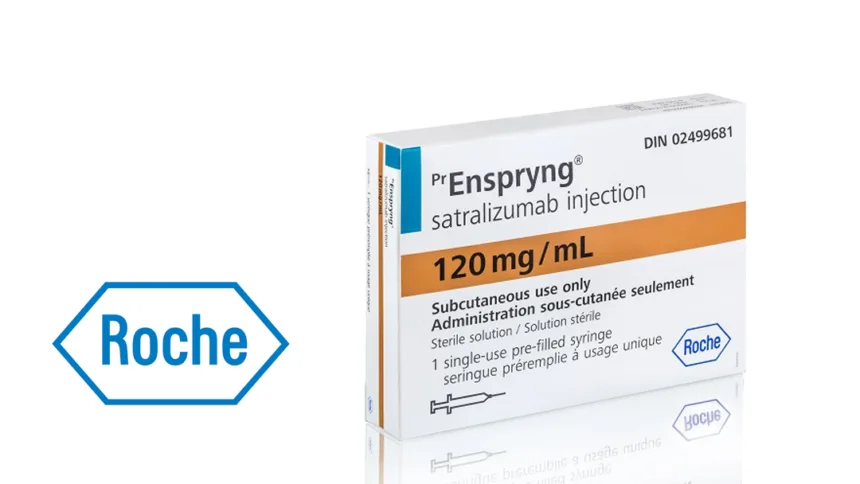
Roche (SWX: ROP; OTCMKTS: RHHBY) announced that the U.S. Food and Drug Administration (FDA) has approved Enspryng (satralizumab) for the treatment of adults with active or chronic thyroid eye disease (TED) – providing patients with the first and only at‑home subcutaneous treatment option for the autoimmune orbital condition. Enspryng, developed by Chugai, a member of the Roche Group, is a humanised monoclonal antibody targeting IL‑6 receptor activity, and the approval extends the franchise beyond its established neuroimmunology indications.
Regulatory Milestone
| Item | Detail |
|---|---|
| Agency | U.S. FDA |
| Approval Type | New indication approval |
| Product | Enspryng (satralizumab) |
| Company | Roche (SWX: ROP; OTCMKTS: RHHBY); developed by Chugai (Roche Group) |
| New Indication | Treatment of adults with active or chronic thyroid eye disease (TED) |
| Differentiation | First and only at‑home subcutaneous treatment option for TED |
| Approval Date | 16 Oct 2026 |
Drug Profile & Mechanism of Action
- Molecule: Satralizumab – a humanised monoclonal antibody developed by Chugai, a member of the Roche Group.
- Target: The IL‑6 receptor (IL‑6R) – IL‑6 is a key chemical messenger involved in the body’s inflammatory response, and its blockade addresses a central driver of TED’s orbital inflammation.
- Recycling Antibody Technology: Engineered with innovative recycling antibody technology, Enspryng enables potent and repeated binding to the IL‑6 receptor compared to traditional antibodies – the molecule is recycled rather than degraded after target engagement.
- Pharmacodynamic Effect: The recycling design achieves sustained IL‑6 inhibition, leading to rapid and durable suppression of the inflammatory pathway.
- Administration: Subcutaneous, at‑home dosing – the first such self‑administered option in TED, removing the infusion‑center burden associated with existing biologic therapy.
Disease Context – Thyroid Eye Disease
- Condition: Thyroid eye disease (TED) is an autoimmune disorder, most often associated with Graves’ disease, in which inflammation of the orbital tissues causes eye bulging (proptosis), pain, double vision and, in severe cases, threat to vision.
- Active vs. Chronic Phases: TED progresses from an active inflammatory phase to a chronic fibrotic phase; the FDA approval covers both active and chronic TED in adults.
- Unmet Need: Treatment options have historically been limited to intravenous biologic therapy, corticosteroids or surgery – making an at‑home subcutaneous option a meaningful access advance for patients (clinical trial data underlying the approval not detailed in the announcement).
Orphan Drug Designations
Enspryng has accumulated a broad set of orphan drug designations (ODD) across neuroimmunological indications:
| Region | Indication |
|---|---|
| United States & European Union | Neuromyelitis optica spectrum disorder (NMOSD) |
| United States & European Union | Myelin oligodendrocyte glycoprotein antibody‑associated disease (MOGAD) |
| United States | Anti‑NMDA receptor autoimmune encephalitis (anti‑NMDAR AIE) |
| United States | Leucine‑rich glioma‑inactivated 1 autoimmune encephalitis (LGI1 AIE) |
The TED approval adds a non‑neurological autoimmune indication to this portfolio, validating the breadth of IL‑6 receptor inhibition as a platform mechanism across antibody‑ and inflammation‑mediated diseases.
Market Impact & Outlook
- TED Market Entry: Enspryng enters the TED biologic market as the first and only at‑home subcutaneous therapy, a convenience advantage over infusion‑based competitors in a disease where long‑term treatment adherence matters.
- Franchise Expansion: The approval diversifies Roche’s Enspryng franchise beyond NMOSD and MOGAD, opening a second commercial front in ophthalmology‑adjacent autoimmunity (market size and launch plans not disclosed).
- Chugai Technology Showcase: The recycling antibody technology underpinning sustained IL‑6 inhibition is a signature Chugai engineering platform – the TED win reinforces its value across multiple indications.
- Watch Items: Investors will monitor U.S. launch execution, potential ex‑U.S. regulatory submissions in TED, and further development in the orphan‑designated anti‑NMDAR AIE and LGI1 AIE indications.
Forward‑Looking Statements
This brief contains forward‑looking statements regarding the commercialization of Enspryng in thyroid eye disease, potential regulatory submissions in additional regions, and development of the asset in orphan‑designated indications. Actual results may differ materially due to risks including competitive dynamics, pricing and reimbursement conditions, launch execution, and further regulatory actions. FDA approval does not guarantee commercial success of the product.-Fineline Info & Tech