



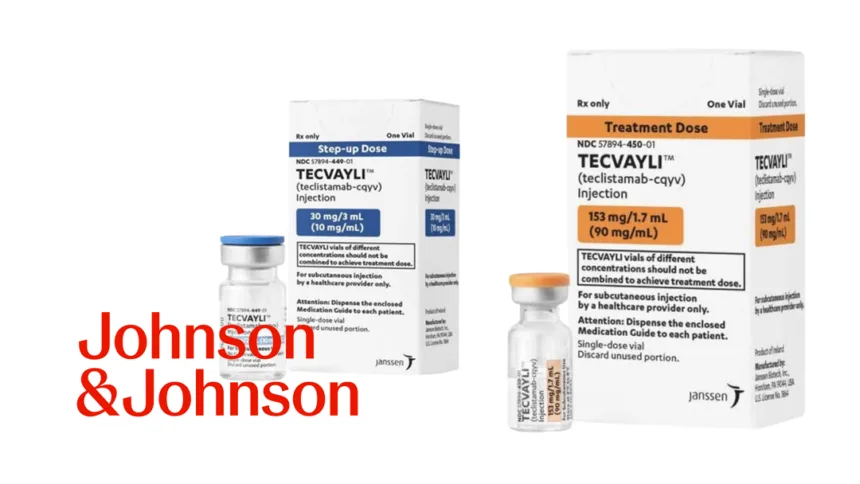
Johnson & Johnson (J&J) (NYSE: JNJ) announced that China’s National Medical Products Administration (NMPA) has approved a new indication for Tecvayli (teclistamab injection) for adult patients with relapsed or refractory multiple myeloma (MM) who have received at least one prior line of therapy, including an anti‑CD38 monoclonal antibody and lenalidomide. The approval moves Tecvayli’s use earlier to the first relapse setting, supported by the Phase III MajesTEC‑9 study showing a 71% reduction in the risk of disease progression or death and a 40% reduction in the risk of death.
Regulatory Milestone
| Item | Detail |
|---|---|
| Agency | NMPA (China) |
| Approval Type | New indication expansion |
| Product | Tecvayli (teclistamab injection) – bispecific antibody |
| New Indication | Adults with relapsed or refractory multiple myeloma (MM) after ≥1 prior line of therapy, including an anti‑CD38 monoclonal antibody and lenalidomide |
| Previous NMPA Indication | Monotherapy for adults with RRMM after ≥3 prior lines, including a proteasome inhibitor, an immunomodulatory agent, and an anti‑CD38 monoclonal antibody |
| Strategic Shift | Moves Tecvayli earlier in the treatment sequence – to the first relapse setting |
| Approval Date | 22 Oct 2026 (announcement) |
| Pivotal Trial | Phase III MajesTEC‑9 |
Drug Profile & Mechanism of Action
- Molecule: Tecvayli (teclistamab injection), a bispecific antibody.
- Dual Targets: B‑cell maturation antigen (BCMA) on myeloma cells and the CD3 receptor on the surface of T lymphocytes – physically bridging T cells to malignant plasma cells to drive immune‑mediated tumor killing.
- Modality Class: T‑cell‑redirecting bispecific immunotherapy, an off‑the‑shelf alternative to CAR‑T in relapsed/refractory multiple myeloma.
- Line-of-Therapy Expansion: Previously reserved for the ≥3 prior lines setting (including a proteasome inhibitor, an immunomodulatory agent, and an anti‑CD38 monoclonal antibody); the new approval extends use to ≥1 prior line, substantially enlarging the eligible patient population in China.
Clinical Evidence – Phase III MajesTEC‑9 Study
| Endpoint | Result (Tecvayli) | Relative Benefit |
|---|---|---|
| Progression‑Free Survival (PFS) | Risk of disease progression or death reduced by 71% | 71% risk reduction |
| Overall Survival (OS) | Risk of death reduced by 40% | 40% risk reduction |
| Study Population | Predominantly patients refractory to anti‑CD38 monoclonal antibodies and lenalidomide | High‑unmet‑need population |
| Statistical Significance | Clinically meaningful and statistically significant benefits in both PFS and OS | Dual primary benefits |
The approval is based on results from the Phase III MajesTEC‑9 study, in which Tecvayli demonstrated clinically meaningful and statistically significant benefits in both progression‑free survival (PFS) and overall survival (OS). In a study population predominantly composed of patients refractory to anti‑CD38 monoclonal antibodies and lenalidomide – a group with notoriously poor outcomes on standard therapy – Tecvayli reduced the risk of disease progression or death by 71% and the risk of death by 40%.
Market Impact & Outlook
- First Relapse Positioning: Moving Tecvayli to the first relapse setting transforms its commercial trajectory in China, shifting from a last‑resort option to an early‑sequence immunotherapy for a much larger RRMM population.
- Dual‑Endpoint Evidence: Statistically significant improvements in both PFS and OS in a refractory population provide a compelling evidentiary basis for clinical adoption and payer discussions.
- China MM Landscape: Multiple myeloma remains largely incurable with high relapse rates; anti‑CD38/lenalidomide‑refractory patients historically had limited effective options, making BCMA/CD3 bispecifics a high‑value addition to China’s myeloma armamentarium.
- Bispecific Franchise Growth: The label expansion strengthens J&J’s hematology franchise in China and reinforces the bispecific modality’s role alongside CAR‑T in RRMM care.
- Next Steps: Reimbursement negotiations and commercial rollout in China; additional line‑of‑therapy or combination expansions were not disclosed beyond this announcement.
Forward‑Looking Statements
This brief contains forward‑looking statements regarding Tecvayli’s new NMPA‑approved indication, clinical benefits observed in the MajesTEC‑9 study, and commercial potential in the first relapse multiple myeloma setting in China. Actual results may differ materially due to risks including reimbursement and pricing decisions, real‑world clinical experience, competitive therapies such as CAR‑T and other bispecifics, and further regulatory actions.-Fineline Info & Tech