


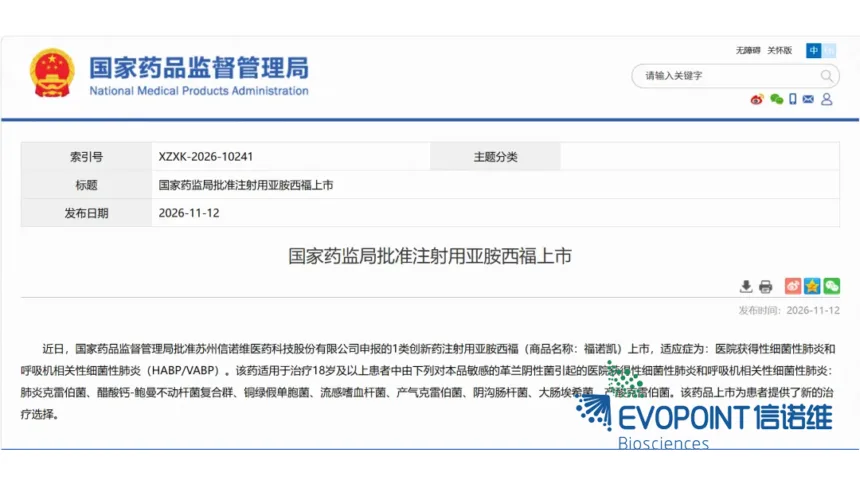
Evopoint Biosciences (SHA: 688837) announced that its Class 1 innovative drug, Imipenem, Cilastatin and Funobactam for Injection (IMI/FUN), has been approved for marketing by China’s National Medical Products Administration (NMPA). The antibiotic is indicated for the treatment of hospital‑acquired bacterial pneumonia (HABP) and ventilator‑associated bacterial pneumonia (VABP) in patients aged 18 years and older caused by specified susceptible Gram‑negative microorganisms.
Regulatory Milestone
| Item | Detail |
|---|---|
| Agency | NMPA (China) |
| Approval Type | Marketing approval, Class 1 innovative drug |
| Product | Imipenem, Cilastatin and Funobactam for Injection (IMI/FUN) |
| Sponsor | Evopoint Biosciences (SHA: 688837) |
| Indication | HABP and VABP in adults (≥ 18 years) caused by susceptible Gram‑negative microorganisms |
| Covered Pathogens | Klebsiella pneumoniae, Acinetobacter calcoaceticus‑baumannii complex, Pseudomonas aeruginosa, Haemophilus influenzae, Klebsiella aerogenes, Enterobacter cloacae, Escherichia coli, Klebsiella oxytoca |
| Approval Date | 12 November 2026 (announced) |
| Pricing / Launch Timeline | Not disclosed |
Drug Profile & Mechanism of Action
- Composition: A fixed triple combination of imipenem (a broad‑spectrum carbapenem antibiotic), cilastatin (a renal dehydropeptidase‑I inhibitor that protects imipenem from degradation), and funobactam – a novel β‑lactamase inhibitor developed by Evopoint (program code XNW4107).
- Rationale: Adding a next‑generation β‑lactamase inhibitor to the established imipenem/cilastatin backbone is designed to restore and extend carbapenem activity against resistant Gram‑negative pathogens – including the label’s high‑priority organisms such as Acinetobacter baumannii complex and Pseudomonas aeruginosa, both WHO‑priority, drug‑resistance‑prone pathogens in hospital settings.
- Target Setting: HABP/VABP – severe nosocomial infections in hospitalized and mechanically ventilated adults, where empiric coverage of resistant Gram‑negatives is a persistent clinical challenge.
- Administration: Intravenous injection formulation, suited to inpatient and ICU use.
Clinical Evidence – REITAB‑2 Phase III Trial
| Item | Detail |
|---|---|
| Study | XNW4107‑302 (REITAB‑2), ClinicalTrials.gov: NCT05204563 |
| Design | International, multicenter, randomized, double‑blind, controlled Phase III trial |
| Population | Adults with HABP or VABP |
| Comparison | IMI/FUN vs. imipenem/cilastatin/relebactam (IMI/REL) – Merck’s marketed carbapenem/β‑lactamase‑inhibitor combination (Recarbrio) |
| Primary Efficacy Endpoint | 14‑day all‑cause mortality |
| Result | IMI/FUN was non‑inferior to IMI/REL |
| Numeric Mortality Data | Not disclosed in the announcement |
| Safety | Favorable safety and tolerability profile |
The head‑to‑head design against IMI/REL – rather than placebo or an older standard of care – sets a rigorous evidentiary bar and positions IMI/FUN directly against the current premium carbapenem‑combination standard in nosocomial pneumonia.
Market Impact & Outlook
- AMR Market Context: Antimicrobial resistance in Gram‑negative nosocomial pathogens is a top global public‑health priority; China’s large hospital and ICU infrastructure creates substantial demand for new β‑lactam/β‑lactamase‑inhibitor combinations.
- Competitive Landscape: IMI/FUN enters a segment where IMI/REL (relebactam) and other novel combinations (e.g., ceftazidime/avibactam, imipenem‑based regimens) compete; demonstrated non‑inferiority in 14‑day all‑cause mortality gives Evopoint a clinically validated entry ticket with a differentiated, domestically developed inhibitor.
- Domestic Innovation Signal: The approval marks another milestone for Evopoint’s anti‑infective franchise and for China’s Class 1 antibiotic innovation, where first‑in‑country novel inhibitors have historically been scarce.
- Commercialization Path: Key next steps include provincial procurement and hospital formulary inclusion, pricing strategy, and any type 2 diabetes‑unrelated indication expansions – none of which were disclosed; launch timing and pricing remain not disclosed.
- Investor Watch Items: First sales contribution, comparative uptake versus IMI/REL, potential stewardship‑driven positioning in ICU empiric protocols, and any international filing ambitions for funobactam combinations.
Forward‑Looking Statements
This brief contains forward‑looking statements regarding Imipenem, Cilastatin and Funobactam for Injection, including commercialization, market uptake, and future development of the product. Actual results may differ due to risks including reimbursement and procurement outcomes, competitive dynamics in the anti‑infective market, antimicrobial stewardship policies, and real‑world safety experience. Pricing, launch timelines, and numeric trial results have not been disclosed.-Fineline Info & Tech