


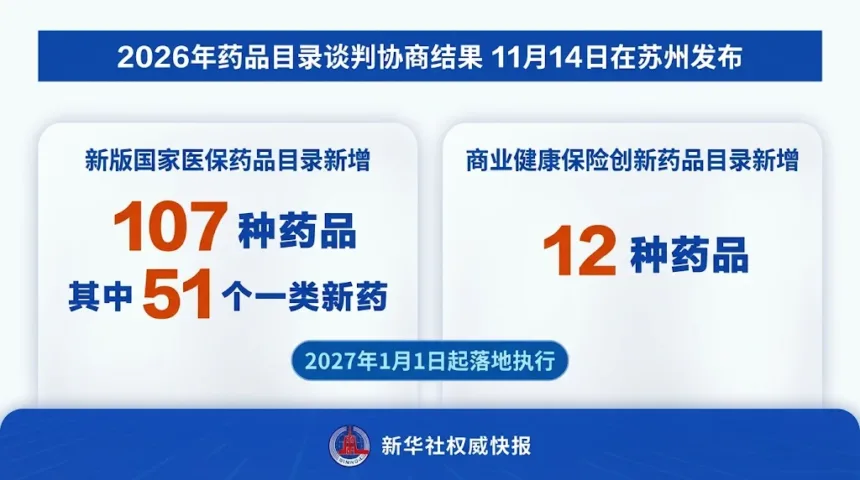
China’s National Healthcare Security Administration (NHSA) released the National Drug List for Basic Medical Insurance, Maternity Insurance, and Work‑Related Injury Insurance (NRDL) and the Commercial Health Insurance Innovative Drug List (2026), marking the ninth NRDL adjustment since the establishment of the NHSA. A total of 107 drugs were newly added, including a record‑high 51 Category 1 innovative drugs, while 34 drugs were removed. The updated lists take effect on January 1, 2027.
Policy Snapshot
| Item | Detail |
|---|---|
| Issuing Agency | National Healthcare Security Administration (NHSA), China |
| Documents Released | NRDL (2026) and Commercial Health Insurance Innovative Drug List (2026) |
| Milestone | Ninth NRDL adjustment since the NHSA’s establishment |
| Drugs Added | 107, including 51 Category 1 innovative drugs – another record high |
| Drugs Removed | 34 – due to limited clinical value, superior alternatives available, or missing package insert information coupled with supply unavailability |
| Commercial List | 28 drugs total, with 12 new additions |
| Effective Date | 1 January 2027 |
| Hospital Adoption Deadline | Pharmacy and therapeutics committees to convene by end of February 2027 to adjust formularies or establish green channels for temporary procurement |
Notable Inclusions – Basic Medical Insurance List
- CAR‑T Cell Therapy: Million‑yuan‑priced relmacabtagene autoleucel (relma‑cel) by JW Therapeutics for lymphoma was successfully included – a landmark reimbursement for ultra‑high‑priced cell therapy.
- Hemophilia Non‑Factor Therapies: Four non‑factor products entered the list: emicizumab (Roche), marstacimab (Pfizer), fitusiran (Sanofi), and bomitase alfa (Staidson) – substantially expanding treatment options beyond traditional factor replacement.
- Commercial Health Insurance Innovative Drug List: The 28‑drug list, with 12 new additions, features major innovative therapies including the world’s first CAR‑T therapy for solid tumors and China’s first gene therapy for hemophilia – creating a tiered coverage pathway for premium‑priced modalities.
Implementation & Hospital Access Requirements
- Formulary Adjustment Obligation: Designated medical institutions for basic medical insurance, and contracted medical and rehabilitation institutions for work‑related injury insurance, are required in principle to convene their pharmacy and therapeutics committees by the end of February 2027 to promptly adjust hospital formularies or establish green channels for temporary procurement, safeguarding clinical treatment needs and patients’ rights to rational medication.
- Regulatory Carve‑Outs: Negotiated drugs are exempt from the “one drug, two specifications” restriction, and hospital adoption shall not be hindered on the grounds of medical insurance total budget caps, hospital formulary quantity limits, or drug‑to‑total‑revenue ratios.
- Local Facilitation: Local authorities are encouraged to take proactive measures to align negotiated drugs with designated medical institutions and pharmacies.
Market Impact & Outlook
- Innovation‑Friendly Signal: With a record 51 Category 1 innovative drugs added in a single cycle, the 2026 adjustment reinforces Beijing’s policy pivot toward rewarding genuine innovation while pruning low‑value products – a dual track that continues to reshape pharma portfolio strategies in China.
- Cell & Gene Therapy Access: The inclusion of million‑yuan CAR‑T therapy in basic insurance and the world’s first solid‑tumor CAR‑T plus China’s first hemophilia gene therapy on the commercial list marks a structural breakthrough for advanced therapy modalities, potentially transforming patient access and volume trajectories for these products.
- Hemophilia Market Expansion: Coverage of four non‑factor therapies positions China’s hemophilia market for a shift from episodic factor replacement toward prophylactic, differentiated regimens – a significant commercial tailwind for Roche, Pfizer, Sanofi, and Staidson.
- Commercial Insurance Layering: The growing Commercial Health Insurance Innovative Drug List formalizes a multi‑payer model, allowing premium‑priced innovations to reach patients through supplementary coverage while easing pressure on the basic insurance fund.
- Enforcement Teeth: Explicit prohibitions against formulary caps and budget‑ratio barriers – coupled with the February 2027 committee deadline – aim to close the historic gap between national negotiation and actual hospital access, a long‑standing pain point for innovative drug launches in China.
Forward‑Looking Statements
This brief contains forward‑looking statements regarding implementation of the 2026 NRDL and Commercial Health Insurance Innovative Drug List, hospital formulary adoption timelines, patient access to negotiated drugs, and commercial expectations for included products. Actual results may differ due to risks including local implementation variability, hospital procurement practices, pricing and volume dynamics, and competitive developments.-Fineline Info & Tech