



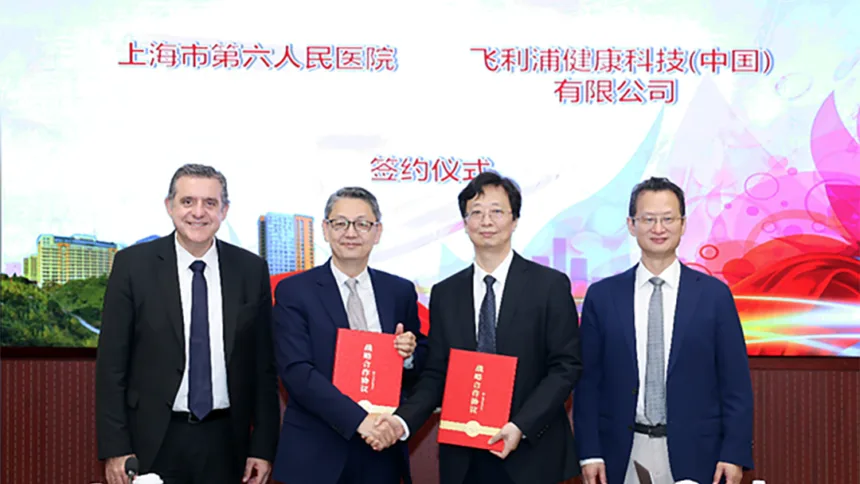
Philips Health and Shanghai Sixth People’s Hospital officially signed a Memorandum of Understanding (MoU) on strategic cooperation, under which the two parties will jointly establish a medical imaging joint laboratory and pursue collaborative research, clinical validation, and talent development across multinuclear magnetic resonance imaging (MRI) and artificial intelligence (AI).
Collaboration Snapshot
| Item | Detail |
|---|---|
| Parties | Philips Health × Shanghai Sixth People’s Hospital |
| Agreement Type | Memorandum of Understanding (MoU) on strategic cooperation |
| Signing Date | 18 Nov 2026 |
| Core Initiative | Joint establishment of a medical imaging joint laboratory |
| Research Focus | Collaborative research and clinical validation in multinuclear MRI and AI; application of cutting‑edge imaging technologies |
| AI Agenda | R&D and application of AI technologies — including large medical models — leveraging clinical data to enhance diagnostic and treatment efficiency and quality |
| Talent & Exchange | Systematic medical imaging talent cultivation; deepened Sino‑European clinical innovation and academic exchanges; broader global cooperation platform via Philips’ network |
Joint Laboratory & AI Initiatives
- Anchor Facility: Focusing on practical clinical needs, the two parties will jointly establish a medical imaging joint laboratory to conduct collaborative research and clinical validation in areas such as multinuclear MRI and AI, exploring the application of cutting‑edge imaging technologies in relevant clinical fields.
- Multinuclear MRI: Multinuclear (multi‑nuclei) MRI extends conventional proton imaging to nuclei such as sodium, phosphorus, and carbon, enabling metabolic and microstructural insights beyond anatomy — a frontier capability for precision diagnosis in musculoskeletal, oncologic, and neurologic disease.
- Large Medical Models: Leveraging the hospital’s clinical data, the partnership will explore the R&D and application of AI technologies, including large medical models, to enhance the efficiency and quality of diagnosis and treatment — aligning with the broader integration of foundation models into imaging workflows.
- Talent Cultivation: The two sides will build a systematic talent cultivation mechanism for medical imaging, deepening Sino‑European clinical innovation, academic exchanges, and interactions among young talents to foster the continuous accumulation of clinical experience and innovative capabilities.
- Global Platform: Drawing on Philips’ global network, both parties will establish a broader platform for exchange and cooperation, bringing innovations and experiences originating from Chinese clinical practice to the world and contributing Chinese wisdom to global healthcare innovation.
Domain Context – Medical Imaging & AI in China
- Imaging Workload Pressure: China’s tier‑one tertiary hospitals face surging imaging volumes and radiologist shortages, making AI‑assisted reading and workflow efficiency a top operational priority.
- Policy Tailwinds: National initiatives promoting AI + healthcare, high‑end medical equipment innovation, and industry‑academia‑hospital collaboration provide a supportive backdrop for joint laboratory models.
- Industry–Hospital Partnership Trend: Device majors increasingly co‑develop imaging innovations with leading Chinese hospitals, using real‑world clinical settings to validate next‑generation MRI and AI algorithms before global rollout.
Market Impact & Outlook
- Strategic Positioning for Philips: Anchoring a joint laboratory at a leading Shanghai tertiary hospital strengthens Philips’ innovation footprint in China’s high‑end imaging market and creates a pipeline of clinically validated, exportable technologies.
- Technology Roadmap: The combination of multinuclear MRI and large medical models targets both hardware and software differentiation — from metabolic imaging capability to AI‑driven diagnostic efficiency — in a market where imaging AI adoption is accelerating.
- Sino‑European Bridge: The MoU’s emphasis on Sino‑European clinical innovation and young‑talent exchange positions the partnership as a two‑way channel, feeding Chinese clinical experience into Philips’ global network and vice versa.
- Undisclosed Elements: Financial terms, laboratory scale, specific research programs, and implementation timelines were not disclosed in the announcement.
Forward‑Looking Statements
This brief contains forward‑looking statements regarding the Philips Health–Shanghai Sixth People’s Hospital strategic cooperation, including the establishment of the joint laboratory, collaborative research programs, and talent cultivation initiatives. Actual results may differ materially due to risks including research execution, regulatory and data‑governance requirements for medical AI, funding and resource allocation, and the evolving landscape of imaging technology and healthcare policy.-Fineline Info & Tech