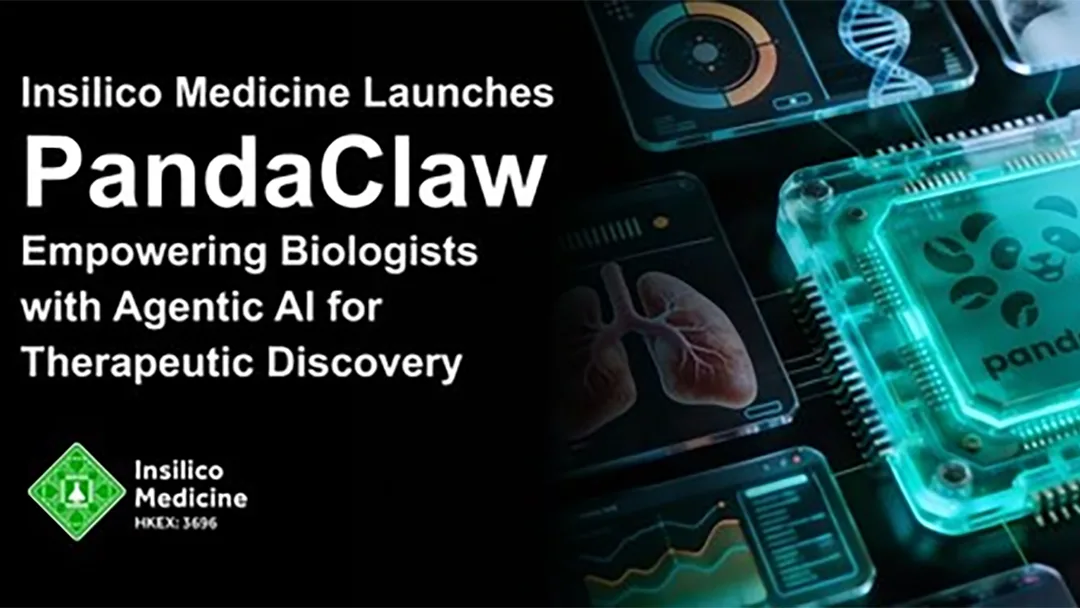
Insilico Medicine (HKG: 3696) announced the launch of PandaClaw, a transformative new feature of its PandaOmics AI engine that integrates AI agents with biological and bioinformatics workflows – enabling researchers to discover novel targets, identify new indications, and build disease hypotheses through an intuitive, intelligent natural language interface that automates complex real‑time analyses and accelerates translational medical research.
Immediate hypothesis testing; iterative research acceleration
Strategic Positioning & Market Context
Dimension
Traditional Bioinformatics
PandaClaw Innovation
User Expertise Required
Specialized programming/statistics skills
Natural language interface – democratizes access for biologists
Analysis Speed
Weeks to months for multi‑omics integration
Real‑time automated analysis
Workflow Integration
Fragmented tools; manual data transfer
Seamless AI‑agent orchestration
Output Quality
Variable; expertise‑dependent
Standardized, publication‑ready reports
Market Impact & Commercial Trajectory
AI‑Drug Discovery Market Dynamics: Global AI‑enabled research tools market US$2‑3 billion (2024); projected US$8‑12 billion by 2030; pharmaceutical R&D productivity crisis drives demand for automation and democratization of complex analytics; PandaClaw addresses bottleneck of specialized bioinformatics expertise scarcity.
PandaOmics Platform Expansion: PandaClaw transforms PandaOmics from target discovery engine to comprehensive research operating system; potential for SaaS licensing model to academic institutions, biotech companies, and pharma R&D; estimated US$50‑100 million annual recurring revenue potential by 2028‑2030 assuming 200‑500 institutional subscriptions.
Competitive Differentiation: vs. Recursion (Map4) – PandaClaw’s natural language interface superior for non‑technical users; vs. Schrödinger (LiveDesign) – broader multi‑omics integration vs. molecular simulation focus; vs. Google DeepMind (AlphaFold) – complementary target discovery vs. structural prediction; integrated workflow automation unique selling proposition.
Partnership Enablement: PandaClaw enhances Insilico’s collaboration value proposition (recent ASKA Pharma deal); partners gain self‑service analytics capability reducing dependency on Insilico internal teams; potential for white‑label licensing to pharma for internal AI platform deployment.
Scientific Validation Imperative: PandaClaw’s AI‑generated hypotheses require experimental validation to establish credibility; Insilico’s internal pipeline success (ISM001‑055 Phase II) provides validation case studies; peer‑reviewed publications using PandaClaw critical for academic adoption.
Forward‑Looking Statements This brief contains forward‑looking statements regarding platform adoption rates, revenue projections, and scientific validation timelines for PandaClaw. Actual results may differ due to competitive product launches, user adoption challenges, and the inherent uncertainty of AI‑generated research hypotheses requiring experimental validation.-Fineline Info & Tech