



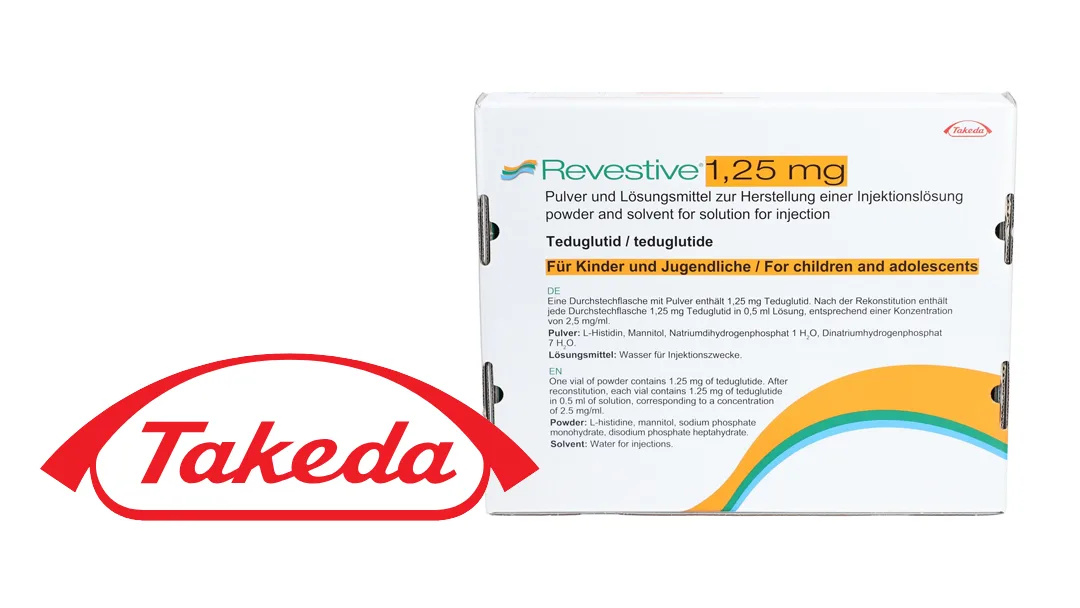
Takeda Pharmaceutical Company Limited (TYO: 4502; NYSE: TAK) announced that China’s National Medical Products Administration (NMPA) has approved the 1.25 mg specification of Revestive (teduglutide for injection), expanding the indication to treat short bowel syndrome (SBS) in pediatric patients with a corrected gestational age of 4 months and older who have undergone intestinal adaptation and remain dependent on parenteral nutrition support.
Regulatory Milestone & Product Expansion
| Item | Detail |
|---|---|
| Agency | NMPA (China) |
| Product | Revestive (teduglutide for injection) – 1.25 mg specification |
| New Indication | Short bowel syndrome in pediatric patients ≥4 months corrected gestational age |
| Approval Date | August 6, 2026 |
| Previous Approval | 5 mg specification approved February 2024 (patients ≥1 year) |
| Patient Criteria | Clinically stable, post-intestinal adaptation, parenteral nutrition dependent |
| Therapeutic Class | Rare digestive disease treatment |
Drug Profile & Clinical Innovation
- Molecule: First human glucagon-like peptide-2 (GLP-2) analogue approved in China for SBS
- Mechanism: Increases villus height and crypt depth → strengthens intestinal epithelial barrier → alleviates local inflammation → improves intestinal permeability → promotes intestinal adaptation
- Therapeutic Goal: Reduce dependence on parenteral nutrition through enhanced intestinal absorption function
- Target Population: Pediatric SBS patients with small intestine length often <2 meters (sometimes <1 meter)
- Administration: Subcutaneous injection with weight-based dosing appropriate for infant populations
Clinical Significance & Unmet Need
Short bowel syndrome represents one of the most challenging rare gastrointestinal disorders, particularly in pediatric populations where surgical resection leaves insufficient intestinal length for adequate nutrient absorption. Nearly all SBS patients require lifelong parenteral nutrition (PN) support, which carries significant risks including catheter-related infections, liver complications, and reduced quality of life.
The approval of the 1.25 mg specification addresses a critical gap for younger infants who previously had no GLP-2 analogue treatment options in China. By extending the age range from ≥1 year to ≥4 months corrected gestational age, Takeda enables earlier intervention during a crucial developmental window when intestinal rehabilitation therapy can have maximal impact on long-term outcomes.
Market Impact & Strategic Positioning
- Addressable Population: Estimated 2,000-3,000 pediatric SBS patients in China, with significant portion under 1 year of age
- Competitive Advantage: First and only GLP-2 analogue available for SBS in China across expanded age range
- Rare Disease Leadership: Reinforces Takeda’s commitment to addressing ultra-rare conditions with high unmet medical need
- Revenue Potential: Premium pricing potential given orphan drug status and limited treatment alternatives
- Global Strategy: Aligns with Takeda’s international SBS franchise while addressing China-specific regulatory requirements
Therapeutic Context & Standard of Care
Intestinal rehabilitation therapy aims to optimize the absorptive capacity of remaining intestinal tissue, potentially reducing or eliminating PN dependence. Teduglutide represents a paradigm shift from purely supportive care to active intestinal restoration, offering hope for improved nutritional independence and quality of life for affected children and their families.
Forward-Looking Statements
This brief contains forward-looking statements regarding regulatory approvals, market potential, and commercial expectations for Revestive. Actual results may differ due to risks including market adoption rates, reimbursement decisions, competitive dynamics, and patient identification challenges in rare disease settings.-Fineline Info & Tech