


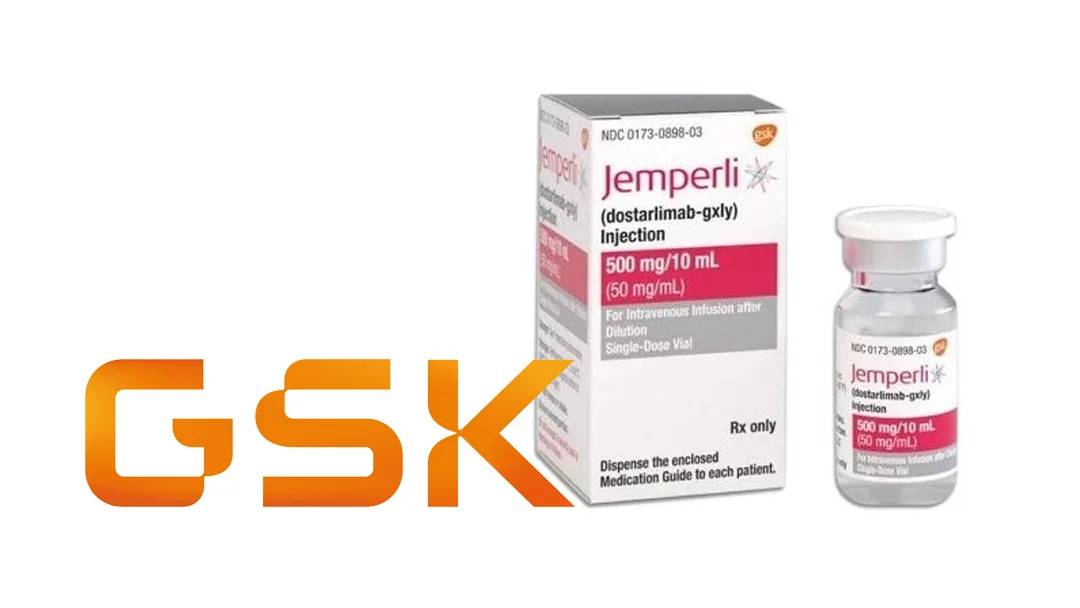
GlaxoSmithKline Plc (GSK, NYSE: GSK) announced that the US Food and Drug Administration (FDA) has accepted for priority review a supplemental Biologics License Application (sBLA) for Jemperli (dostarlimab) in patients with previously untreated stage II and III mismatch repair deficient (dMMR)/microsatellite instability‑high (MSI‑H) locally advanced rectal cancer. The FDA assigned a PDUFA action date of February 2027, and the application is also eligible for expedited review through the National Priority Voucher program.
Regulatory Milestone
| Item | Detail |
|---|---|
| Agency | FDA (US) |
| Review Designation | Priority review; eligible for National Priority Voucher expedited pathway |
| Product | Jemperli (dostarlimab), anti‑PD‑1 monoclonal antibody |
| Indication | Previously untreated stage II/III dMMR/MSI‑H locally advanced rectal cancer |
| PDUFA Action Date | February 2027 |
| Supporting Data | Registrational Phase II AZUR‑1 trial (single‑arm) |
Drug Profile & Mechanism of Action
- Molecule: Jemperli (dostarlimab) – anti‑PD‑1 monoclonal antibody
- Mechanism: Blocks the PD‑1 checkpoint pathway, restoring T‑cell–mediated anti‑tumor immune responses
- Indication Expansion: Move into the first‑line treatment of locally advanced rectal cancer
- Safety Profile: Interim AZUR‑1 data show tolerability generally consistent with Jemperli’s well‑characterised and manageable profile observed across solid tumours
Clinical Evidence – AZUR‑1 Trial
| Endpoint | Outcome |
|---|---|
| Primary Endpoint – cCR12 | Met: meaningful and sustained clinical complete response rate at 12 months |
| Durability | No detectable signs of cancer for at least one year in responders |
| Safety | Generally consistent with known, manageable PD‑1 class profile |
The registrational Phase II single‑arm AZUR‑1 study met its primary objective by demonstrating a sustained clinical complete response rate at 12 months (cCR12) — a result that, if confirmed, could support an organ‑preservation strategy and reduce reliance on surgery and radiation in this biomarker‑selected population.
Market Impact & Outlook
- Unmet Need: dMMR/MSI‑H locally advanced rectal cancer has historically been managed with chemoradiation and surgery; a durable complete response opens a watch‑and‑wait, organ‑preserving treatment paradigm.
- Regulatory Catalyst: A February 2027 PDUFA date provides a clear binary event for investors tracking GSK’s oncology pipeline monetisation.
- Competitive Edge: PD‑1 blockade has shown outsized response rates in dMMR/MSI‑H tumours versus standard approaches, a segment where immunotherapy holds a structural advantage.
- Pipeline Synergy: A first‑line rectal cancer label would broaden Jemperli’s footprint alongside its existing endometrial cancer indications, strengthening GSK’s oncology franchise.
Forward‑Looking Statements
This brief contains forward‑looking statements regarding regulatory timelines, clinical outcomes, and commercial expectations for Jemperli. Actual results may differ due to risks including final FDA review outcomes, market adoption, and competitive dynamics.-Fineline Info & Tech