


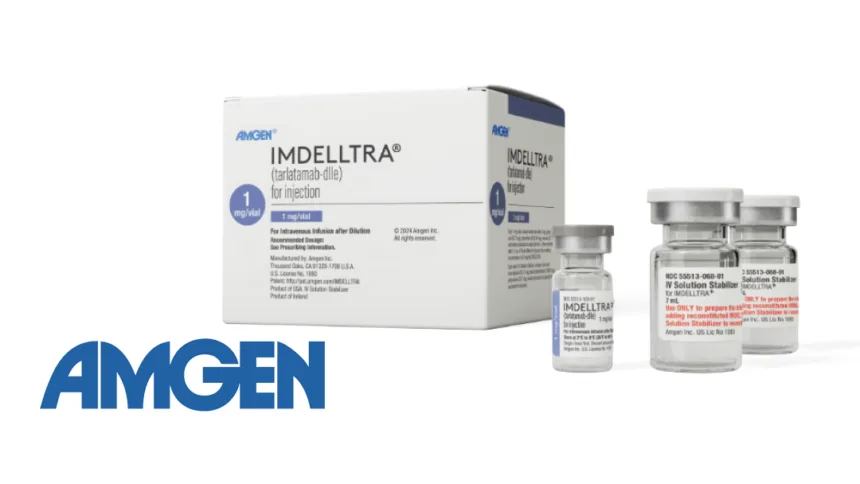
Amgen (NASDAQ: AMGN) announced that the U.S. Food and Drug Administration (FDA) has approved an update to the prescribing information for Imdelltra (tarlatamab), substantially reducing the recommended monitoring time for the first two doses of treatment in an appropriate healthcare setting — from 22–24 hours down to 6–8 hours from the start of infusion.
Label Update Snapshot
| Item | Detail |
|---|---|
| Agency | U.S. FDA |
| Action | Prescribing information update approved |
| Product | Imdelltra (tarlatamab) |
| Drug Class | First‑in‑class bispecific T‑cell engager (BiTE) targeted immunotherapy |
| Indication | DLL3‑expressing small cell lung cancer (SCLC) |
| Previous Monitoring Requirement | 22–24 hours from start of each of the first two infusions |
| Updated Monitoring Requirement | 6–8 hours from the start of each of the first two infusions |
| Additional Requirement | Next‑day follow‑up assessment, including vital signs, after each of the first two doses |
| Scope | Limited to the first two doses |
| Announcement Date | 14 Sep 2026 |
Drug Profile & Mechanism of Action
- Molecule: Tarlatamab (Imdelltra) — a first‑in‑class targeted immunotherapy engineered by Amgen researchers.
- Dual Target: Designed to bind to both DLL3 on tumor cells and CD3 on T cells, physically bridging immune effector cells to the tumor.
- Mechanism: The dual binding activates T cells to kill DLL3‑expressing small cell lung cancer cells, resulting in the formation of a cytolytic synapse and the lysis of cancer cells.
- Target Rationale: DLL3 is an inhibitory Notch ligand aberrantly expressed on the surface of the majority of small cell lung cancers while largely absent from normal adult tissues, making it a selective tumor antigen for T‑cell redirection.
Label Update Details
- Substantially Shortened Monitoring: Patients receiving Imdelltra should now be monitored for 6 to 8 hours from the start of their first two infusions, down from the previously recommended 22 to 24 hours — a reduction of roughly two‑thirds.
- Next‑Day Assessment: Patients will also receive a follow‑up assessment, including vital signs, the day after each of the first two doses.
- Setting: Monitoring remains required in an appropriate healthcare setting for the initial doses.
- Limited Scope: The label update applies only to the first two doses; monitoring requirements for subsequent dosing are unchanged by this update.
- Clinical Rationale Context: Extended initial monitoring for T‑cell engagers is a standard risk‑mitigation measure around cytokine release syndrome (CRS), which occurs predominantly during early doses; the reduction reflects accumulated safety experience with tarlatamab. (Basis for the update not detailed in the announcement.)
Market Impact & Outlook
- Reduced Treatment Burden: Cutting first‑dose monitoring from up to a full day to 6–8 hours materially lowers the logistical burden on patients, caregivers and infusion centers — a meaningful quality‑of‑care improvement in a disease population with limited life expectancy.
- Site Capacity and Access: Shorter chair time in appropriate healthcare settings can expand infusion capacity and reduce hospitalization or overnight‑stay requirements, potentially broadening the number of sites able to initiate Imdelltra therapy.
- Commercial Uptake Support: Easing administration friction strengthens the practical value proposition of Imdelltra in second‑line and beyond extensive‑stage SCLC, supporting continued uptake of Amgen’s flagship oncology launch.
- Class Precedent: The update sets a constructive precedent for bispecific T‑cell engagers generally, demonstrating that real‑world safety data can support de‑escalation of early monitoring requirements.
- Strategic Positioning: The label improvement reinforces Amgen’s leadership in T‑cell‑engager oncology and its DLL3‑directed franchise in small cell lung cancer, one of the deadliest and fastest‑progressing tumor types.
Forward‑Looking Statements
This brief contains forward‑looking statements regarding Imdelltra (tarlatamab), including the impact of the updated prescribing information on treatment delivery, patient access and commercial adoption. Actual results may differ materially due to risks including safety experience in routine practice, prescriber and site uptake, competitive dynamics, and reimbursement conditions.-Fineline Info & Tech