


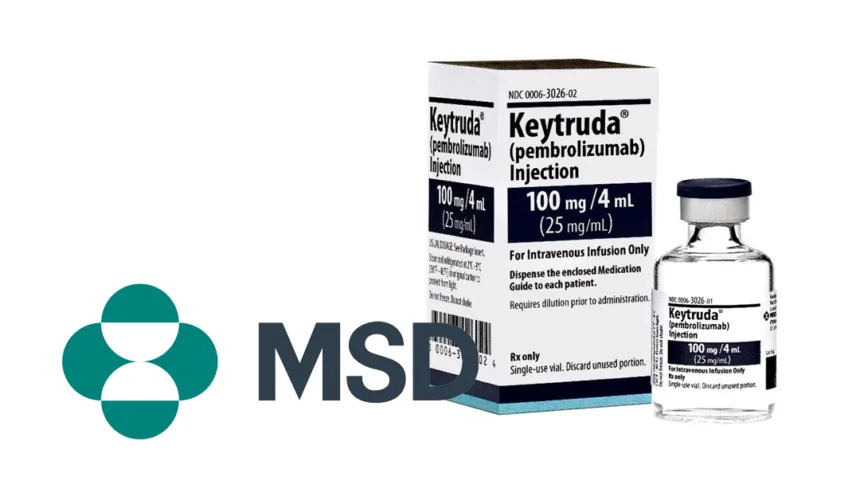
Merck & Co., Inc. (MSD; NYSE: MRK) announced that Japan’s Ministry of Health, Labour and Welfare (MHLW) has approved KEYTRUDA QLEX (pembrolizumab and berahyaluronidase alfa‑pmph), a subcutaneous formulation of its anti‑PD‑1 therapy pembrolizumab, for all indications approved in Japan for KEYTRUDA (pembrolizumab). In Japan, KEYJECT is the planned trademark for KEYTRUDA QLEX.
Regulatory Milestone
| Item | Detail |
|---|---|
| Agency | Ministry of Health, Labour and Welfare (MHLW), Japan |
| Approval Type | Marketing approval – full-label substitution across existing indications |
| Product | KEYTRUDA QLEX (pembrolizumab and berahyaluronidase alfa-pmph), subcutaneous |
| Japan Trademark | KEYJECT (planned) |
| Indications | All indications approved in Japan for KEYTRUDA (pembrolizumab) |
| Approval Basis | Pivotal Phase III MK-3475A-D77 clinical trial |
| Announcement Date | 21 Sep 2026 |
Drug Profile & Mechanism of Action
- Molecule: KEYJECT pairs pembrolizumab with berahyaluronidase alfa‑pmph, an enzyme that transiently degrades hyaluronan to enable subcutaneous delivery of the large antibody.
- Mechanism: Pembrolizumab is an anti‑programmed death receptor‑1 (PD‑1) therapy that blocks the interaction between PD‑1 and its ligands, PD‑L1 and PD‑L2, thereby activating T lymphocytes which may affect both tumor cells and healthy cells.
- Route Advantage: Subcutaneous administration replaces intravenous infusion, shortening chair time and easing administration logistics across KEYTRUDA’s broad oncology label.
- Franchise Extension: The approval extends the KEYTRUDA franchise – one of the world’s largest oncology brands – into a patient‑ and site‑of‑care‑friendly formulation without narrowing its indication set in Japan.
Clinical Evidence – Phase III MK-3475A-D77 Trial
| Endpoint | KEYJECT + Chemotherapy | KEYTRUDA + Chemotherapy | Outcome |
|---|---|---|---|
| Pharmacokinetic Exposure | Comparable to KEYTRUDA | Reference arm | PK comparability demonstrated |
| Overall Response Rate (ORR), descriptive | 45% (95% CI, 39–52) | 42% (95% CI, 33–51) | Consistent between arms |
| Progression-Free Survival (PFS) | No notable differences vs KEYTRUDA | – | Comparable |
| Overall Survival (OS) | No notable differences vs KEYTRUDA | – | Comparable |
The pivotal MK-3475A-D77 trial evaluated KEYJECT administered every six weeks in combination with chemotherapy versus KEYTRUDA administered every six weeks in combination with chemotherapy in treatment‑naïve patients with metastatic non‑small cell lung cancer (NSCLC) harboring no EGFR, ALK, or ROS1 genomic tumor aberrations. The trial demonstrated comparable pharmacokinetic exposure levels between KEYJECT and KEYTRUDA; in descriptive analyses, ORR was consistent at 45% versus 42%, and no notable differences in PFS or OS were observed between the two arms.
Market Impact & Outlook
- Full-Label Substitution in Japan: Approval for all KEYTRUDA indications allows Japanese clinicians to transition patients across the entire pembrolizumab label – from NSCLC to melanoma and beyond – to the subcutaneous route.
- Health System Efficiency: Subcutaneous delivery every six weeks reduces infusion chair occupancy and nursing workload, an operational gain for Japan’s capacity-constrained oncology settings.
- Lifecycle Management: KEYJECT strengthens KEYTRUDA’s competitive position against intravenous biosimilar entry and rival checkpoint inhibitors, particularly as the franchise navigates the patent landscape through the late 2020s.
- Global Alignment: The MHLW decision follows the subcutaneous pembrolizumab regulatory momentum internationally, reinforcing Merck’s strategy of defending its flagship franchise through formulation innovation.
- Launch Details: Japan pricing, reimbursement listing timing, and commercial rollout plans for KEYJECT – not disclosed.
Forward‑Looking Statements
This brief contains forward‑looking statements regarding market launch, reimbursement outcomes, clinical adoption, and commercial performance of KEYJECT in Japan. Actual results may differ materially due to risks including pricing and reimbursement decisions, competitive dynamics, and real‑world uptake.-Fineline Info & Tech