


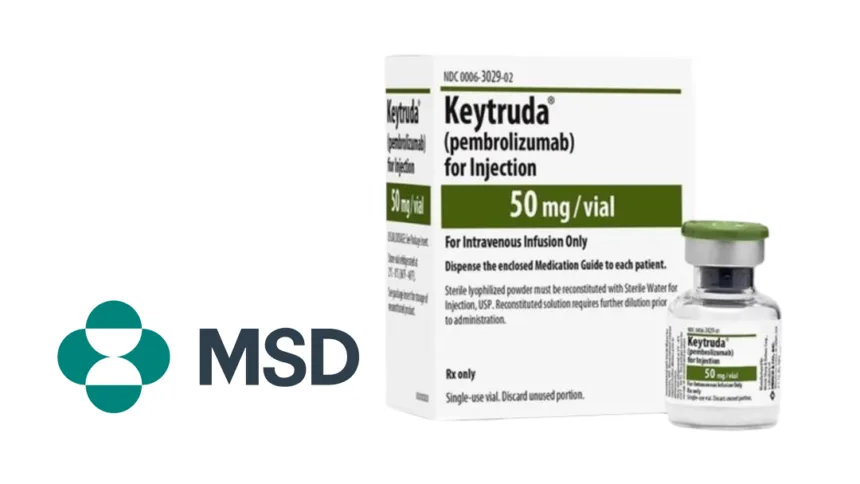
Merck & Co., Inc. (MSD; NYSE: MRK) announced that China’s National Medical Products Administration (NMPA) has approved the subcutaneous injection formulation of pembrolizumab, its blockbuster PD‑1 inhibitor, across 19 solid tumor indications — making it the first and currently only PD‑1 inhibitor available as a subcutaneous injection in China.
Regulatory Milestone
| Item | Detail |
|---|---|
| Agency | NMPA (China) |
| Approval Type | Marketing approval – new subcutaneous formulation |
| Product | Pembrolizumab subcutaneous injection (PD‑1 inhibitor) |
| Scope | 19 solid tumor indications, spanning monotherapy, chemotherapy combinations, perioperative and chemoradiotherapy settings |
| Approval Date | 29 Sep 2026 |
| Distinction | First and only subcutaneously administered PD‑1 inhibitor in China |
| Launch & Reimbursement | Not disclosed |
Drug Profile & Mechanism of Action
- Molecule: Pembrolizumab — a humanized monoclonal antibody targeting the PD‑1 receptor, and the core asset of Merck’s global oncology franchise.
- Formulation Innovation: The approved subcutaneous injection offers an alternative to conventional intravenous (IV) infusion across the approved label.
- Mechanism of Action: Blocks PD‑1 interaction with its ligands PD‑L1 and PD‑L2, releasing the PD‑1 pathway–mediated brake on T cells and restoring anti‑tumor immune surveillance.
- Delivery Advantage: Subcutaneous administration can substantially shorten administration time versus a standard ~30‑minute IV infusion, reducing infusion‑chair occupancy and easing the burden on hospital resources and patients.
- Biomarker‑Guided Use: Several approved settings require companion‑diagnostic stratification, including PD‑L1 TPS/CPS thresholds and MSI‑H/dMMR status determined by NMPA‑approved or fully validated tests.
Approved Indications at a Glance
| Tumor Type | Setting | Regimen | Key Biomarker Criteria |
|---|---|---|---|
| Melanoma | Unresectable or metastatic | Pembrolizumab SC | — |
| NSCLC | First‑line, locally advanced or metastatic | Monotherapy | EGFR−/ALK−; PD‑L1 TPS ≥ 1% (NMPA‑approved test) |
| NSCLC (non‑squamous) | First‑line, metastatic | + pemetrexed and platinum chemotherapy | EGFR−/ALK− |
| NSCLC (squamous) | First‑line, metastatic | + carboplatin and paclitaxel | — |
| NSCLC (resectable Stage II–IIIB) | Perioperative | Neoadjuvant with platinum‑containing chemotherapy → adjuvant pembrolizumab monotherapy | — |
| Esophageal / gastroesophageal junction (GEJ) carcinoma | First‑line, locally advanced unresectable or metastatic | + platinum‑ and fluoropyrimidine‑based chemotherapy | — |
| Esophageal squamous cell carcinoma (ESCC) | After failed prior first‑line systemic therapy | Monotherapy | PD‑L1 CPS ≥ 10 (NMPA‑approved test) |
| Head and neck squamous cell carcinoma (HNSCC) | First‑line, metastatic or unresectable recurrent | Monotherapy | PD‑L1 CPS ≥ 1 (fully validated test) |
| Colorectal cancer (CRC) | First‑line, unresectable or metastatic | Monotherapy | MSI‑H/dMMR; KRAS, NRAS, BRAF wild‑type |
| Hepatocellular carcinoma (HCC) | Unresectable, non‑metastatic | + lenvatinib and transarterial chemoembolization (TACE) | — |
| HCC | After sorafenib or oxaliplatin‑containing chemotherapy | Monotherapy | — |
| Biliary tract cancer (BTC) | First‑line, locally advanced or metastatic | + gemcitabine and cisplatin | — |
| Triple‑negative breast cancer (TNBC) | High‑risk early stage, perioperative | Neoadjuvant with chemotherapy → adjuvant pembrolizumab monotherapy | PD‑L1 CPS ≥ 20 (fully validated test) |
| MSI‑H/dMMR advanced solid tumors (tissue‑agnostic) | Adults after prior treatment (CRC post fluoropyrimidine/oxaliplatin/irinotecan; other tumors with no satisfactory alternative options) | Monotherapy | MSI‑H/dMMR |
| Gastric / GEJ adenocarcinoma (HER2‑negative) | First‑line, locally advanced unresectable or metastatic | + fluoropyrimidine‑ and platinum‑containing chemotherapy | HER2‑negative |
| Gastric / GEJ adenocarcinoma (HER2‑positive) | First‑line, locally advanced unresectable or metastatic | + trastuzumab + fluoropyrimidine‑ and platinum‑containing chemotherapy | HER2‑positive; PD‑L1 CPS ≥ 1 (fully validated test) |
| Cervical cancer | FIGO 2014 Stage III–IVA | + chemoradiotherapy (CRT) | — |
| Urothelial carcinoma | Locally advanced or metastatic, adults | + enfortumab vedotin for injection | — |
Market Impact & Outlook
- China Immuno‑Oncology Landscape: China’s PD‑1 market is among the world’s most competitive, with multiple imported and domestic antibodies — nearly all delivered intravenously. A subcutaneous‑only first‑mover position gives Merck a differentiated route of administration no rival currently matches in China.
- Breadth‑of‑Label Advantage: Approval across 19 solid tumor indications at launch — spanning lung, gastrointestinal, hepatobiliary, breast, gynecologic, urologic and skin cancers, plus a tissue‑agnostic MSI‑H/dMMR setting — provides immediate, broad patient access rather than an indication‑by‑indication rollout.
- Health‑System Efficiency: Shorter administration frees infusion capacity at Chinese tier‑1 hospitals and may enable treatment closer to patients’ homes, a meaningful factor given the scale of China’s cancer patient population.
- Lifecycle Management: The subcutaneous formulation strengthens pembrolizumab’s competitive moat and extends franchise value as core patent protection on the molecule approaches expiry later this decade.
- Commercialization: Launch timing, pricing and National Reimbursement Drug List (NRDL) status were not disclosed in the announcement.
Forward‑Looking Statements
This brief contains forward‑looking statements regarding regulatory timelines, clinical outcomes, market adoption, and commercial expectations for subcutaneous pembrolizumab in China. Actual results may differ materially due to risks including reimbursement outcomes, competitive dynamics, manufacturing and supply considerations, and evolving standards of care.-Fineline Info & Tech