



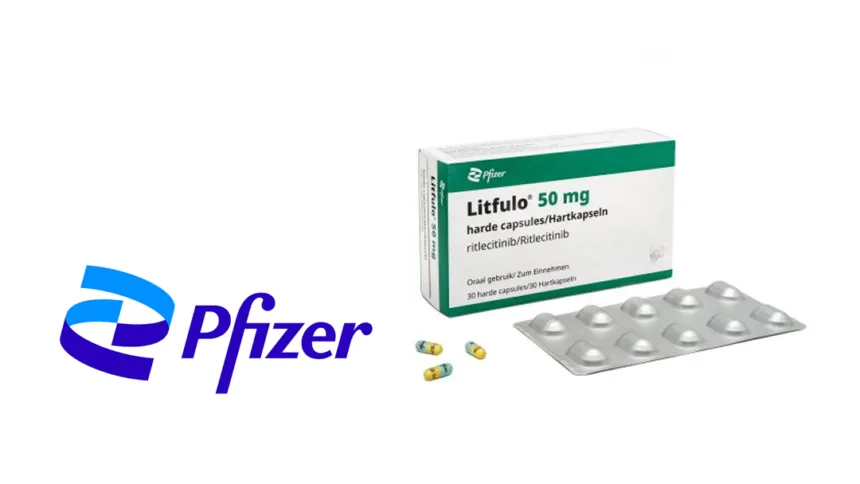
Pfizer Inc. (NYSE: PFE) announced that ritlecitinib (brand name Litfulo), an oral kinase inhibitor, met the primary endpoints in two Phase III trials in nonsegmental vitiligo, with data presented at the 2026 European Academy of Dermatology and Venereology (EADV) Annual Congress. The TRANQUILLO program — 2,174 patients across 271 research centers worldwide — is the largest Phase III clinical program ever conducted for an oral systemic vitiligo therapy, and Pfizer plans to use the data for global regulatory submissions.
Clinical Development Milestone
| Item | Detail |
|---|---|
| Company | Pfizer Inc. (NYSE: PFE) |
| Product | Ritlecitinib (Litfulo), oral JAK3/TEC family kinase inhibitor |
| Indication | Nonsegmental vitiligo |
| Data Disclosure | 2 Oct 2026, EADV 2026 Annual Congress |
| Trial Program | TRANQUILLO 2 (adults, 100 mg QD) + TRANQUILLO (ages 12+, 50 mg); 2,174 patients, 271 global sites |
| Outcome | Both Phase III studies met their primary endpoints |
| Next Steps | Global marketing authorization submissions planned based on TRANQUILLO data |
Drug Profile & Mechanism of Action
- Molecule: Ritlecitinib, a once‑daily oral small‑molecule kinase inhibitor
- Target: JAK3 and TEC family kinases, modulating the immune pathways that drive melanocyte destruction
- Approved Use: Already on the market for alopecia areata; the vitiligo program expands the molecule into a second autoimmune dermatology indication
- Differentiation: An oral systemic option in a disease historically managed with topical agents, offering mechanism‑level intervention on disease progression
Clinical Evidence – Phase III TRANQUILLO Program
| Endpoint (Week 52) | TRANQUILLO 2 – Ritlecitinib 100 mg | TRANQUILLO 2 – Placebo | TRANQUILLO – Ritlecitinib 50 mg | TRANQUILLO – Placebo |
|---|---|---|---|---|
| F‑VASI75 (≥75 % facial improvement) | 21.86 % | 2.40 % | 12.47 % | 2.48 % |
| T‑VASI50 (≥50 % total‑body improvement) | 13.02 % | 2.40 % | 8.98 % | 1.98 % |
TRANQUILLO 2 enrolled 1,567 adults receiving 100 mg once daily, while TRANQUILLO enrolled 607 patients aged 12 and above at the 50 mg dose. Repigmentation was observable as early as Week 24 and persisted through Week 52. Approximately 75 %–77 % of ritlecitinib‑treated patients maintained disease stability, versus roughly 60 % on placebo.
- Safety Profile: Consistent with ritlecitinib’s approved alopecia areata indication; no new safety signals identified
- Treatment‑Emergent AEs (TRANQUILLO 2, 100 mg): 67.7 % vs. 62.0 % for placebo
- Serious AEs: 3.4 % in both arms
- Most Common AEs: Upper respiratory tract infection, nasopharyngitis, headache, and elevated blood creatine phosphokinase
Market Impact & Outlook
- Disease Burden: Vitiligo is an autoimmune skin disorder with a global prevalence of ~0.5 %–2 %, in which the immune system attacks melanocytes and causes depigmentation; treatment options have long been extremely limited.
- Competitive Landscape: AbbVie’s upadacitinib won EU approval in July 2026 as the world’s first approved systemic therapy for vitiligo. Incyte’s povorcitinib has also reported positive Phase III results and plans a regulatory filing in H1 2027, which would give Incyte both topical (Opzelura cream) and oral vitiligo franchises.
- Paradigm Shift: With three oral JAK inhibitors now delivering positive Phase III data, vitiligo care is migrating from a topical‑first model toward systemic oral intervention.
- Patient Impact: For the tens of millions of vitiligo patients worldwide, ritlecitinib’s potential approval would provide an oral option that intervenes in disease progression at the immune‑mechanism level, beyond existing topical therapies.
Forward‑Looking Statements
This brief contains forward‑looking statements regarding regulatory submissions, approval timelines, clinical outcomes, and commercial expectations for ritlecitinib in vitiligo. Actual results may differ materially due to risks including regulatory review outcomes, competitive dynamics, and market adoption.-Fineline Info & Tech