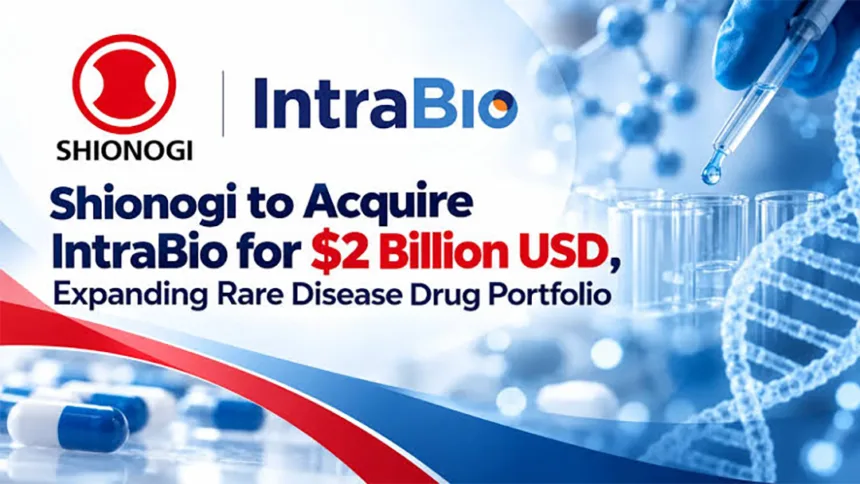
Shionogi & Co., Ltd. (TYO: 4507) announced a definitive agreement to acquire IntraBio, a biopharmaceutical company focused on developing and commercializing therapies for neurodegenerative diseases, for an upfront cash consideration of US$2.0 billion payable to IntraBio shareholders. Upon closing, IntraBio will become a wholly owned subsidiary of Shionogi Inc., Shionogi’s New Jersey‑based U.S. subsidiary. The acquisition centers on AQNEURSA® (levacetylleucine), an FDA‑approved therapy for two rare neurodegenerative indications — Niemann‑Pick disease Type C (NPC) and Ataxia‑Telangiectasia (A‑T) — with a third regulatory filing currently under review at the European Medicines Agency (EMA).
US$2.0 billion (upfront cash to IntraBio shareholders)
Consideration Form
100% cash
Structure
Acquisition of all outstanding shares; IntraBio to become a wholly owned subsidiary of Shionogi Inc.
Key Asset
AQNEURSA® (levacetylleucine)
Conditions
Customary closing conditions
Announcement Date
5 October 2026
Flagship Asset – AQNEURSA® (Levacetylleucine)
Regulatory Approvals
Market
Indication
Approval Date
U.S. FDA
Neurological manifestations of Niemann‑Pick disease Type C (NPC) — adult and pediatric patients
September 2024
European Medicines Agency (EMA)
Neurological manifestations of NPC — adult and pediatric patients
January 2026
U.S. FDA
Treatment of Ataxia in adult and pediatric patients with Ataxia‑Telangiectasia (A‑T)
18 September 2026
Pending Regulatory Review
Market
Indication
Status
EMA
Treatment of A‑T — adult and pediatric patients
Under review
Drug Profile
Generic Name: Levacetylleucine
Brand Name: AQNEURSA®
Developer: IntraBio
Mechanism: Levacetylleucine is an acetylated derivative of leucine designed to modulate neuronal membrane function and restore cellular homeostasis in lysosomal storage and neurodegenerative disorders. Its mechanism is distinct from substrate reduction therapies and enzyme replacement approaches.
Patient Population: Adult and pediatric patients across both NPC and A‑T — underscoring the drug’s broad age‑group applicability in rare disease populations.
Multi‑Indication Strategy: AQNEURSA has achieved a dual‑indication, dual‑geography regulatory profile within two years of its first approval, demonstrating a platform approach to rare neurodegenerative diseases.
Indication Profiles
Niemann‑Pick Disease Type C (NPC)
Disease: NPC is a rare, progressive, fatal lysosomal storage disorder caused by mutations in the NPC1 or NPC2 genes, leading to impaired intracellular cholesterol trafficking and accumulation of lipids in neurons.
Clinical Manifestations: Progressive neurological deterioration including ataxia, vertical supranuclear gaze palsy, dysarthria, dysphagia, cognitive decline, and psychiatric symptoms.
Prevalence: Estimated ~1 in 100,000 live births, though underdiagnosis suggests true prevalence may be higher.
Prior Therapeutic Gap: Before AQNEURSA, miglustat (Zavesca®) was the only approved NPC therapy in certain jurisdictions, with limited efficacy and significant side effects. No FDA‑approved therapy existed in the U.S. prior to AQNEURSA’s September 2024 approval.
Ataxia‑Telangiectasia (A‑T)
Disease: A‑T is a rare, autosomal recessive, multisystem disorder caused by mutations in the ATM gene, characterized by progressive cerebellar ataxia, immunodeficiency, telangiectasias, and cancer predisposition.
Clinical Manifestations: Progressive neurodegeneration leading to loss of ambulation, speech difficulties, recurrent infections, and shortened life expectancy.
Prevalence: Estimated ~1 in 40,000–100,000 live births.
Prior Therapeutic Gap:No approved therapy existed for A‑T‑related ataxia prior to AQNEURSA’s FDA approval in September 2026, making it a first‑in‑class treatment for this indication.
Strategic Rationale
Rare Disease Platform Acquisition: Beyond AQNEURSA, the transaction adds IntraBio’s rare disease development and commercialization capabilities to Shionogi — a strategic asset class that complements Shionogi’s growing specialty pharmaceutical portfolio.
U.S. Commercial Infrastructure: IntraBio’s established presence in the U.S. rare disease market provides Shionogi with direct access to the world’s largest rare disease reimbursement environment, where orphan drug pricing and favorable reimbursement dynamics support premium product economics.
Shionogi’s Neurology Expansion: The acquisition accelerates Shionogi’s strategic expansion into neurodegenerative diseases — one of the highest‑value therapeutic areas in global pharmaceuticals — building on the company’s existing strengths in infectious diseases (notably its HIV franchise with dolutegravir) and specialty care.
Multi‑Indication Upside: AQNEURSA’s demonstrated efficacy across two mechanistically distinct rare neurodegenerative diseases (NPC and A‑T) suggests potential for further label expansion into additional lysosomal storage disorders, ataxias, and neurodegenerative conditions — an optionality that extends well beyond the current US$2.0 billion upfront price.
Market Impact & Outlook
Rare Disease Valuation Premium: At US$2.0 billion, the acquisition reflects the premium valuation commanded by rare disease platforms with approved, multi‑indication assets. Orphan drugs in neurodegenerative diseases typically command annual treatment costs of US$100,000–500,000+ per patient, with favorable reimbursement dynamics in both the U.S. and EU markets.
NPC + A‑T Combined Market: While individually rare, the combination of NPC and A‑T creates a multi‑indication orphan franchise with diversified revenue streams across two patient populations and two geographies (U.S. + EU), with potential for additional indication expansion.
EMA A‑T Review as Near‑Term Catalyst: The pending EMA review for AQNEURSA in A‑T represents a near‑term value‑accretive catalyst — a positive opinion would grant AQNEURSA dual‑indication, dual‑geography status, significantly expanding the addressable patient population and revenue base.
Shionogi’s M&A Strategy: The IntraBio acquisition is consistent with Shionogi’s stated strategy of complementing organic growth with strategic bolt‑on acquisitions in specialty therapeutic areas. The company has been actively diversifying beyond its infectious disease heritage through targeted deals.
Competitive Landscape: AQNEURSA’s competitive position in NPC includes competition from miglustat (where available) and emerging gene therapy and substrate reduction therapy candidates in earlier development stages. In A‑T, AQNEURSA has no approved competitor, providing a significant first‑mover advantage.
Platform Optionality: IntraBio’s broader rare disease pipeline and capabilities beyond AQNEURSA — while not detailed in this announcement — provide additional long‑term strategic value and potential pipeline synergies with Shionogi’s internal R&D programs.
Deal Structure Simplicity: The all‑cash, all‑shares structure at a fixed US$2.0 billion upfront price provides certainty for both parties, with no milestone‑based contingencies that could create post‑closing disputes or misaligned incentives.
Forward‑Looking Statements This brief contains forward‑looking statements regarding the expected closing of the acquisition, integration plans, regulatory outcomes for AQNEURSA (including the pending EMA review for A‑T), and commercial expectations. Actual results may differ materially due to risks including satisfaction of closing conditions, regulatory approval timelines, market adoption of AQNEURSA in approved indications, competitive dynamics in the rare neurodegenerative disease space, reimbursement and pricing negotiations, integration execution, and the inherent uncertainties of pharmaceutical commercialization. The transaction may not close on the anticipated timeline or at all. Investors are advised to exercise caution.-Fineline Info & Tech
Insight, China's Pharmaceutical Industry Fineline Info & Tech is a comprehensive global pharmaceutical database that spans the entire product lifecycle. Its mission is to equip professionals and executives across all sectors of the life sciences industry with a standardized data language, offering a holistic view of the Chinese pharmaceutical competitive landscape. Flcube.com furnishes critical data essential for informed decision-making, drawing on global industry news, policy insights, competitive intelligence, and advanced analytical tools.