



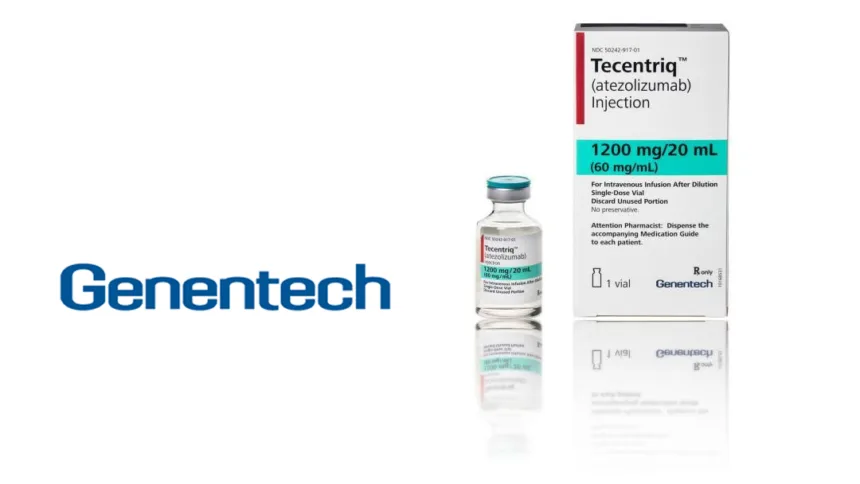
Genentech, a member of the Roche Group (SWX: ROP; OTCMKTS: RHHBY), announced that the U.S. Food and Drug Administration (FDA) has approved Tecentriq (atezolizumab) and Tecentriq Hybreza (atezolizumab and hyaluronidase‑tqjs), in combination with a fluoropyrimidine and oxaliplatin, for the adjuvant treatment of stage III deficient DNA mismatch repair (dMMR) colon cancer.
Regulatory Milestone
| Item | Detail |
|---|---|
| Agency | FDA (United States) |
| Approval Type | New indication (adjuvant setting) |
| Product | Tecentriq (atezolizumab) IV / Tecentriq Hybreza (atezolizumab + hyaluronidase‑tqjs) subcutaneous |
| Indication | Adjuvant treatment of stage III dMMR colon cancer in combination with fluoropyrimidine + oxaliplatin |
| Approval Date | 08 Oct 2026 |
| Companion Diagnostic | IHC assay such as the VENTANA MMR RxDx Panel |
Drug Profile & Mechanism of Action
- Molecule: Atezolizumab – a fully humanized IgG1 monoclonal antibody targeting PD‑L1 (programmed death‑ligand 1).
- Target: PD‑L1 on tumor cells and tumor‑infiltrating immune cells; blockade restores T‑cell–mediated anti‑tumor immunity.
- Subcutaneous Option: Tecentriq Hybreza co‑formulates atezolizumab with hyaluronidase‑tqjs, enabling subcutaneous administration and shorter infusion‑center time.
- Rationale in dMMR: dMMR tumors exhibit high microsatellite instability (MSI‑H) and elevated neoantigen burden, rendering them particularly responsive to immune checkpoint inhibition.
Clinical Evidence – Phase III ATOMIC Study
| Endpoint | Result (Tecentriq + mFOLFOX6) | Comparator (mFOLFOX6 Alone) | Relative Benefit |
|---|---|---|---|
| Risk of Recurrence or Death | Hazard ratio consistent with 50 % reduction | – | 50 % risk reduction |
| 36‑Month Disease‑Free Survival | 86 % | 76 % | +10 ppt |
| Safety Profile | Consistent with known profiles of Tecentriq and mFOLFOX6 | – | No new safety signals |
The ATOMIC trial is a Phase III, randomized, open‑label study evaluating the addition of Tecentriq to modified FOLFOX6 (mFOLFOX6) chemotherapy in the adjuvant setting for patients with stage III dMMR colon cancer, as determined by an immunohistochemistry (IHC) test such as the VENTANA MMR RxDx Panel. The study met its primary endpoint of disease‑free survival (DFS), establishing the first immunotherapy‑chemotherapy combination to demonstrate a statistically significant and clinically meaningful DFS benefit in this population.
Market Impact & Outlook
- dMMR Colon Cancer Landscape: Approximately 15 % of colon cancers harbor dMMR/MSI‑H status; the adjuvant setting has historically relied on chemotherapy alone, leaving a significant unmet need for immunotherapy‑driven approaches.
- Competitive Positioning: Tecentriq becomes the first PD‑L1 inhibitor approved in the adjuvant colon cancer indication, extending Roche’s immuno‑oncology franchise beyond the metastatic setting.
- Subcutaneous Differentiation: Tecentriq Hybreza offers a subcutaneous alternative, reducing chair time and improving patient convenience – a growing competitive axis in the checkpoint inhibitor market.
- Commercial Outlook: The approval broadens Tecentriq’s labeled indications and strengthens its portfolio across lung, urothelial, breast, hepatocellular, and now colorectal cancers, supporting long‑term revenue diversification for Roche.
Forward‑Looking Statements
This brief contains forward‑looking statements regarding the clinical benefits, commercial adoption, and competitive positioning of Tecentriq and Tecentriq Hybreza in the adjuvant dMMR colon cancer indication. Actual results may differ due to risks including post‑marketing safety findings, reimbursement determinations, competitive developments, and regulatory actions in other jurisdictions.-Fineline Info & Tech