


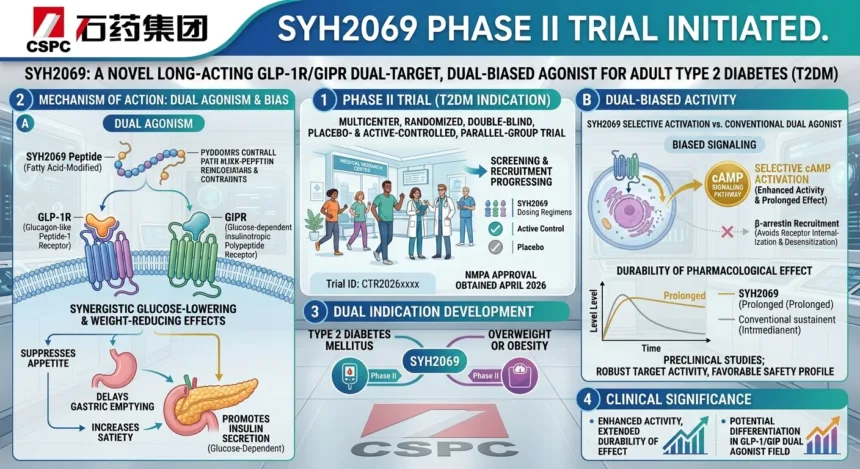
CSPC Pharmaceutical Group Limited (HKG: 1093) announced that the Phase II clinical trial (SYH2069‑003) of its self‑developed candidate SYH2069 for the treatment of adult type 2 diabetes has officially been initiated at its first clinical site in China. SYH2069 is a novel fatty acid‑modified peptide long‑acting dual agonist with dual‑biased activity targeting both the glucagon‑like peptide‑1 receptor (GLP‑1R) and the glucose‑dependent insulinotropic polypeptide receptor (GIPR).
Trial Initiation
| Item | Detail |
|---|---|
| Sponsor | CSPC Pharmaceutical Group Limited (HKG: 1093) |
| Product | SYH2069 – self‑developed candidate |
| Trial ID | SYH2069‑003 |
| Phase | Phase II |
| Indication | Adult type 2 diabetes |
| Milestone | Officially initiated at first clinical site in China |
| Initiation Date | 16 Sep 2026 |
| Trial Design / Dosing Regimen | Not disclosed |
Drug Profile & Mechanism of Action
- Molecule: A novel fatty acid‑modified peptide long‑acting dual agonist — fatty acid modification supports extended duration of action; specific dosing interval not disclosed.
- Dual Targets: Selectively activates GLP‑1R and GIPR, stimulating insulin secretion in a glucose‑dependent manner.
- Expected Efficacy Profile: Designed to synergistically reduce blood glucose levels and promote weight loss by suppressing appetite, delaying gastric emptying, increasing satiety, and reducing caloric intake.
- Biased Signaling Innovation: By selectively activating the downstream cyclic adenosine monophosphate (cAMP) signaling pathway of GLP‑1R and GIPR, SYH2069 avoids receptor internalization and desensitization caused by β‑arrestin recruitment — thereby enhancing its activity and prolonging its duration of action.
- Preclinical Data: Preclinical studies demonstrated that the product possesses potent target activity and a manageable safety profile. Human Phase II datasets are not yet available.
Scientific Context – The Biased Dual‑Agonist Paradigm
- GLP‑1R/GIPR dual agonism is an established frontier in metabolic disease, with the class validated by first‑generation dual incretin therapies; competition centers on efficacy depth, tolerability, and duration.
- Biased agonism represents a next‑generation design principle: preferential engagement of the cAMP pathway over β‑arrestin–mediated signaling is intended to limit receptor internalization and desensitization — mechanisms that can blunt response over time — supporting sustained receptor activity with potentially less frequent dosing.
- Unmet Need: Adult type 2 diabetes in China affects a large patient population with substantial demand for therapies that combine glycemic control with weight reduction; specific epidemiological figures were not cited in the announcement.
Market Impact & Outlook
- Self‑Developed Asset: SYH2069 is independently developed by CSPC, preserving full domestic rights and positioning the company within the fast‑advancing incretin class; global licensing or partnership plans were not disclosed.
- Differentiation Strategy: The dual‑biased, long‑acting design is CSPC’s key claimed differentiator versus existing GLP‑1R/GIPR agonists, aiming for enhanced activity and prolonged action through signaling selectivity.
- Pipeline Momentum: Phase II initiation marks SYH2069’s entry into clinical proof‑of‑concept stage for type 2 diabetes; expansion into obesity or additional metabolic indications was not disclosed.
- Next Catalysts: Patient enrollment across additional sites, Phase II readouts on glycemic and weight endpoints, and safety data — timing not disclosed.
Forward‑Looking Statements
This brief contains forward‑looking statements regarding the clinical development of SYH2069, including its expected mechanisms, efficacy potential, and trial progression. Trial initiation does not guarantee positive results or regulatory approval. Preclinical findings may not translate into clinical benefit. Actual results may differ materially due to risks including clinical outcomes, safety findings, regulatory review, and competitive dynamics.-Fineline Info & Tech