



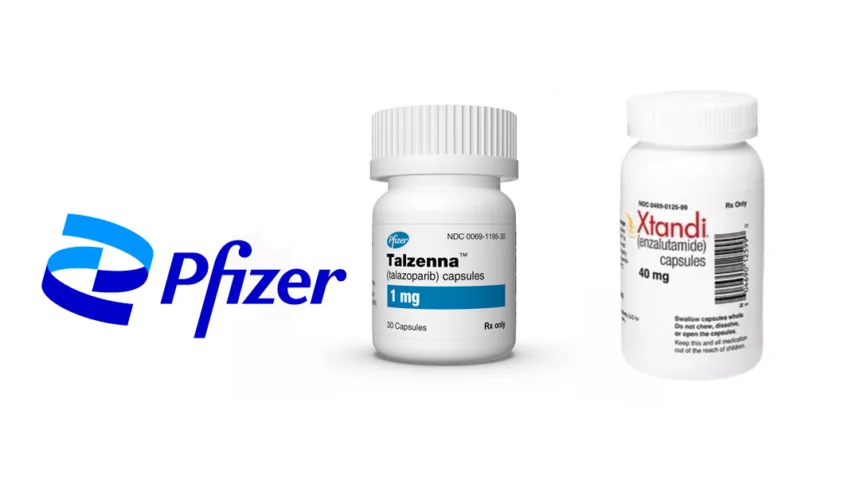
Pfizer Inc. (NYSE: PFE) announced that the U.S. Food and Drug Administration (FDA) has expanded the approval of TALZENNA (talazoparib) in combination with XTANDI (enzalutamide) to include men with metastatic androgen pathway modulation‑naïve or ‑sensitive (mAPMN/S) prostate cancer carrying homologous recombination repair (HRR) gene mutations — encompassing both BRCA and non‑BRCA mutations. The sNDA received FDA Priority Review and was supported by the Phase 3 TALAPRO‑3 clinical study.
Regulatory Milestone
| Item | Detail |
|---|---|
| Agency | U.S. FDA |
| Approval Type | Indication expansion (Priority Review) |
| Products | TALZENNA (talazoparib) + XTANDI (enzalutamide) combination |
| New Indication | mAPMN/S (metastatic hormone-sensitive) prostate cancer with HRR gene mutations, incl. BRCA and non‑BRCA |
| Prior Indication | HRRm metastatic castration-resistant prostate cancer (mCRPC), approved 2023 |
| Supporting Evidence | Phase 3 TALAPRO‑3 study |
| Announcement Date | 26 Oct 2026 |
Drug Profile & Mechanism of Action
- TALZENNA (talazoparib): An oral poly ADP‑ribose polymerase (PARP) inhibitor that exploits synthetic lethality in tumors with deficient homologous recombination repair.
- XTANDI (enzalutamide): An androgen receptor pathway inhibitor (ARPI), a backbone therapy across the prostate cancer continuum.
- Rationale for Combination: Pairing PARP inhibition with androgen receptor pathway blockade targets two complementary drivers of tumor survival, a strategy now validated for use in an earlier line of treatment.
- Population Definition: mAPMN/S — also known as metastatic hormone-sensitive prostate cancer (mHSPC) — describes patients whose disease has not yet progressed on, or is still responsive to, androgen pathway modulation, distinguishing it from the castration-resistant setting of the 2023 approval.
Clinical Evidence – Phase 3 TALAPRO‑3
- Study Role: TALAPRO‑3 served as the pivotal Phase 3 trial supporting the expanded mAPMN/S indication.
- Endpoint Data: Specific efficacy results were not disclosed in the announcement; Priority Review designation signals FDA recognition of the potential for meaningful clinical improvement in this earlier-line setting.
- Mutation Scope: The approval covers the full HRR mutation spectrum — both BRCA and non‑BRCA alterations — rather than restricting benefit to the BRCA subgroup common to many PARP inhibitor labels.
Market Impact & Outlook
- Earlier-Line Access: Moving the combination from mCRPC (2023) into mHSPC substantially enlarges the eligible patient pool, as hormone-sensitive disease precedes castration resistance in the metastatic treatment journey.
- Competitive Landscape: The PARP + ARPI combination class has become a central battleground in biomarker-selected prostate cancer; TALZENNA + XTANDI now competes for earlier-line share with rival ARPI-based regimens.
- Precision Medicine Positioning: With approval spanning BRCA and non‑BRCA HRR mutations, routine germline and somatic genomic testing becomes increasingly consequential for front-line metastatic prostate cancer management.
- Franchise Value: XTANDI remains a key Pfizer oncology revenue pillar; an earlier-line combination label extends its franchise runway alongside TALZENNA’s growth potential.
Forward‑Looking Statements
This brief contains forward‑looking statements regarding TALZENNA and XTANDI, including commercialization of the expanded mAPMN/S indication and further TALAPRO‑3 data disclosures. Actual results may differ due to risks including market uptake, reimbursement and formulary decisions, competitive therapies, and additional regulatory actions.-Fineline Info & Tech