



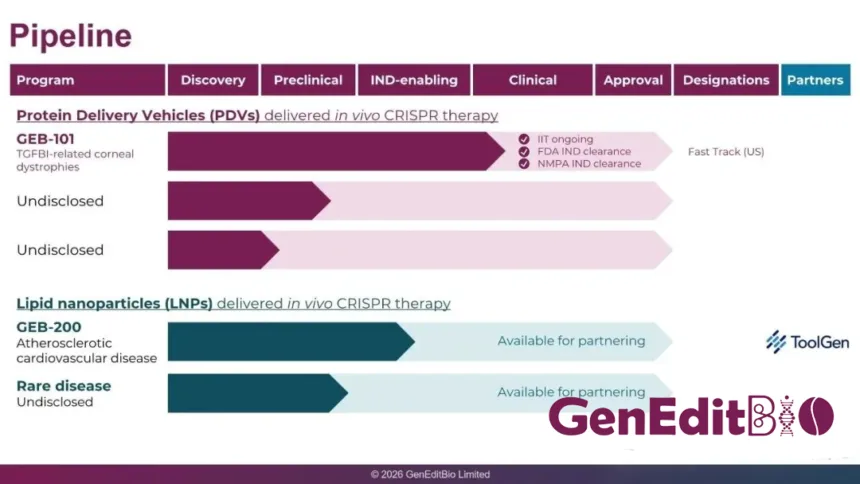
GenEditBio announced that the US Food and Drug Administration (FDA) has granted Fast Track Designation to GEB‑101, a first‑in‑class investigational somatic genome‑editing drug, for the treatment of TGFBI‑related corneal dystrophies. The designation builds on prior clinical trial approvals from the FDA (December 2025) and China’s NMPA (July 2026), accelerating development of a single‑injection therapy that targets the genetic root cause of the disease.
Regulatory Milestone
| Item | Detail |
|---|---|
| Agency | US FDA |
| Designation | Fast Track Designation |
| Product | GEB‑101 (investigational somatic genome‑editing drug) |
| Indication | TGFBI gene‑related corneal dystrophies |
| Announcement Date | 16 September 2026 |
| Prior Clearances | US FDA clinical trial approval (Dec 2025); China NMPA clinical trial approval (Jul 2026) |
| Fast Track Benefits | More frequent FDA communication and eligibility for rolling review of marketing application sections |
Drug Profile & Mechanism of Action
- Molecule: GEB‑101, a first‑in‑class investigational somatic genome‑editing drug wholly developed by GenEditBio.
- Technology: Built on CRISPR‑Cas genome‑editing technology, targeting specific sites within the TGFBI gene.
- Delivery: Precisely delivered in vivo via the company’s proprietary engineered protein delivery vehicle (PDV) — a non‑viral protein‑based delivery system.
- Administration: A single intrastromal corneal injection, designed for localized, one‑time treatment of the affected cornea.
- Therapeutic Concept: Treat TGFBI‑related corneal dystrophies at the root cause by editing the disease‑driving gene in corneal cells, rather than managing symptoms or replacing tissue.
Regulatory Pathway – US & China
- December 2025: US FDA granted clinical trial approval for GEB‑101.
- July 2026: China’s NMPA granted clinical trial approval, enabling parallel development in the company’s home market.
- September 2026: FDA Fast Track Designation adds expedited‑pathway tools to the US program, reflecting the seriousness of the condition and the absence of disease‑modifying therapies.
- Trial Stage Details: Phase, enrollment status, and endpoints of the ongoing clinical program not disclosed.
Market Impact & Outlook
- Disease Landscape: TGFBI‑related corneal dystrophies are inherited disorders causing progressive corneal opacity and vision loss; current care relies on symptomatic management and, in advanced cases, corneal transplantation, with no approved gene‑level therapy.
- First‑in‑Class Positioning: As a wholly internally developed candidate combining CRISPR‑Cas editing with a proprietary protein delivery vehicle, GEB‑101 differentiates from viral‑vector gene therapies in both delivery precision and manufacturing profile.
- Expedited Development: Fast Track Designation can shorten the path to potential approval through closer FDA interaction and rolling review, a meaningful advantage for a rare‑disease asset.
- Dual‑Market Strategy: Concurrent US and China clinical clearances position GenEditBio to pursue registrations in the two largest pharmaceutical markets, expanding the commercial reach of its PDV platform.
Forward‑Looking Statements
This brief contains forward‑looking statements regarding regulatory timelines, clinical development, and commercial expectations for GEB‑101. Fast Track Designation does not guarantee approval. Actual results may differ due to risks including clinical trial outcomes, genome‑editing safety and efficacy findings, subsequent regulatory review requirements, and competitive dynamics in ophthalmic gene therapy.-Fineline Info & Tech