


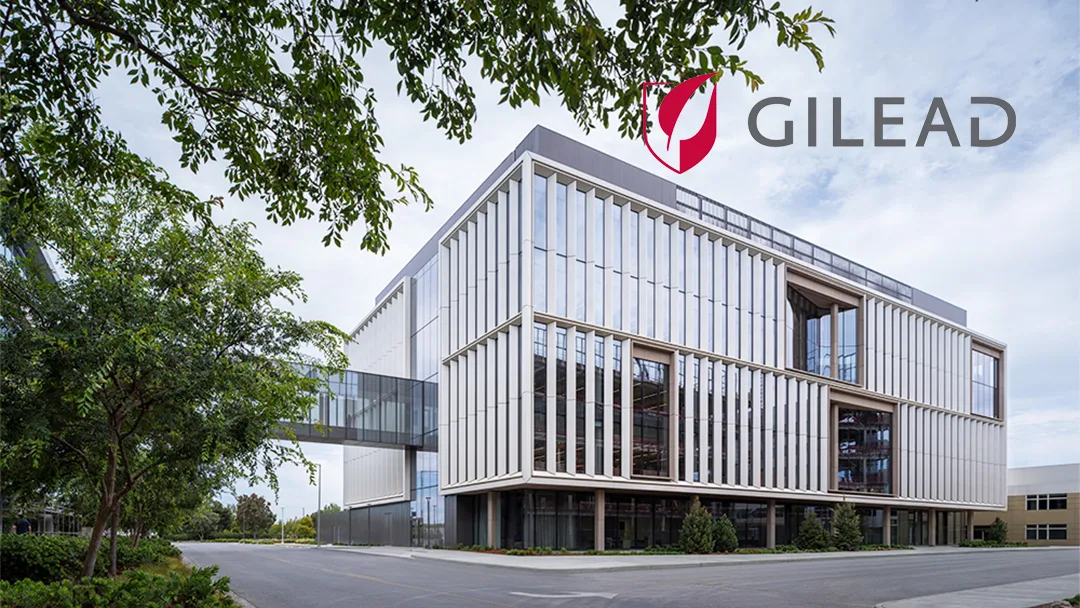
Gilead Sciences, Inc. (NASDAQ: GILD) announced the opening of its 182,000‑square‑foot Research Center at the company’s Foster City headquarters, expanding capabilities in oncology, inflammation, and research data science to advance medicines for some of the world’s most challenging diseases — one of three major Foster City projects advancing Gilead’s broader U.S. investment in research, development, and manufacturing through 2030.
Facility Snapshot
| Item | Detail |
|---|---|
| Facility | Gilead Research Center (newly opened) |
| Size | 182,000 square feet |
| Location | Foster City, California — Gilead global headquarters |
| Company | Gilead Sciences, Inc. (NASDAQ: GILD) |
| Research Focus | Oncology; inflammation; research data science |
| Announcement Date | 8 Sep 2026 |
| Strategic Context | One of three major Foster City projects under Gilead’s U.S. investment program through 2030 |
| Not Disclosed | Capital cost, headcount, opening timeline, and identity/status of the two remaining Foster City projects |
Research Center Profile & Strategic Rationale
- Mission: Expanding discovery capabilities to advance medicines for some of the world’s most challenging diseases, anchored in three declared research pillars.
- Oncology Pillar: Supports Gilead’s multi‑year rebuild of its oncology portfolio beyond its virology heritage — an area centered on cell therapy and targeted programs where discovery throughput and translational science depend on tightly integrated laboratory and computational infrastructure.
- Inflammation Pillar: Positions Gilead in immune‑mediated disease, a field that has produced some of pharma’s largest commercial franchises and demands deep immunology expertise.
- Research Data Science Pillar: Reflects the industry‑wide migration toward AI‑enabled drug discovery — modern discovery centers are designed to co‑locate wet‑lab scientists with computational teams so that structural biology, omics datasets, and machine‑learning models inform candidate selection in continuous loops rather than sequential handoffs.
- California Foundation: The new Research Center builds on Gilead’s longstanding presence in California, leveraging one of the deepest biopharma talent pools in the world around the San Francisco Bay Area.
- Three‑Project Program: The facility is one of three major Foster City projects advancing the company’s broader U.S. investment in research, development, and manufacturing through 2030.
Market Impact & Outlook
- Domestic Commitment Signal: By anchoring three major campus projects within a U.S. investment program running through 2030, Gilead is reinforcing its domestic R&D and manufacturing base at a time when Washington has pressed large pharmaceutical companies to expand onshore operations — a posture carrying policy value alongside operational substance.
- Pipeline Ambitions Confirmed: The concentration of new capacity in oncology, inflammation, and data science signals long‑horizon commitment to internal innovation as the company diversifies revenue beyond its HIV and liver‑disease franchises, rather than relying solely on licensing and M&A to refill the pipeline.
- Regional Ecosystem Effect: The expansion adds stable demand for discovery‑stage scientists and computational talent in a Bay Area biotech labor market that has contracted since the 2022–2023 funding downturn — a counter‑cyclical signal from one of the region’s largest employers.
- Key Metrics to Watch: Headcount growth at the Research Center, pipeline milestones originating from the expanded oncology and inflammation platforms, integration of data‑science capabilities into candidate‑selection timelines, and disclosure of the two remaining Foster City projects. Investment amount and employment figures were not disclosed in the announcement.
Forward‑Looking Statements
This brief contains forward‑looking statements regarding Gilead’s U.S. investment program, facility expansion plans, and research priorities through 2030. Actual results may differ due to risks including changes in corporate R&D strategy, the pace of the remaining Foster City projects, shifts in U.S. manufacturing and health policy, and the inherent uncertainty of translating expanded discovery capacity into clinical candidates.-Fineline Info & Tech