


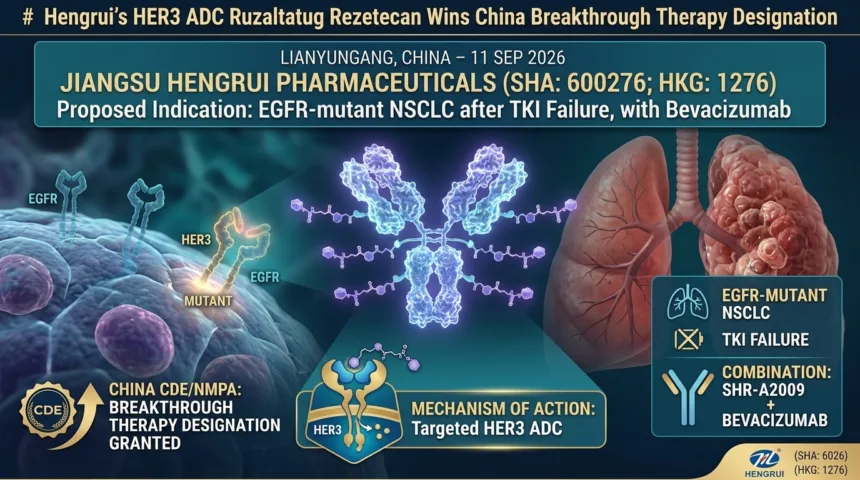
Jiangsu Hengrui Pharmaceuticals Co., Ltd. (SHA: 600276; HKG: 1276) announced that ruzaltatug rezetecan for injection (code: SHR‑A2009), its internally developed HER3‑targeted antibody‑drug conjugate (ADC), has been granted Breakthrough Therapy Designation by the Center for Drug Evaluation (CDE) of China’s National Medical Products Administration (NMPA). The proposed indication is in combination with bevacizumab for patients with EGFR‑mutated locally advanced or metastatic non‑squamous non‑small cell lung cancer (NSCLC) who have failed prior EGFR tyrosine kinase inhibitor (TKI) therapy.
Regulatory Milestone
| Item | Detail |
|---|---|
| Agency | CDE of the NMPA (China) |
| Designation Type | Breakthrough Therapy Designation |
| Product | Ruzaltatug rezetecan for injection (SHR‑A2009) |
| Modality | HER3‑targeted antibody‑drug conjugate (ADC) |
| Proposed Indication | With bevacizumab, for EGFR‑mutated locally advanced or metastatic non‑squamous NSCLC after prior EGFR TKI failure |
| Announcement Date | 11 Sep 2026 |
| Next Steps | Not disclosed; BTD typically enables intensive CDE guidance and expedited review pathways in China |
Drug Profile & Mechanism of Action
- Molecule: Ruzaltatug rezetecan (SHR‑A2009), an internally developed antibody‑drug conjugate.
- Target: HER3 (ERBB3), a receptor tyrosine kinase broadly expressed on tumor cells.
- Mechanism: The ADC specifically binds HER3 on the tumor‑cell surface, is internalized and transported to lysosomes, where the conjugate is hydrolyzed to release the free cytotoxic payload, killing tumor cells.
- Biomarker Rationale: HER3 is expressed in approximately 82.7 % of NSCLC tumors, and HER3 expression is upregulated after EGFR TKI treatment – positioning ruzaltatug rezetecan as a mechanistically suited agent to overcome EGFR TKI resistance.
- Combination Strategy: Paired with bevacizumab (anti‑VEGF), pairing targeted cytotoxicity with angiogenesis blockade in the post‑TKI setting.
- Clinical Data: Trial endpoints and efficacy results were not disclosed in the announcement.
Clinical & Market Context
- Unmet Need: Resistance to EGFR TKIs remains a central challenge in EGFR‑mutated NSCLC, a mutation especially prevalent in Asian populations; options after TKI failure are limited and largely chemotherapy‑based.
- HER3 ADC Landscape: HER3 has emerged as a validated ADC target in oncology, with several programs advancing globally – ruzaltatug rezetecan places Hengrui in direct competition in one of the field’s hottest segments.
- Post‑TKI Positioning: The designation underscores CDE recognition of the therapy’s potential in a defined, high‑need patient population rather than a broad first‑line setting.
Market Impact & Outlook
- Pipeline Milestone: Breakthrough Therapy Designation adds a key regulatory catalyst to Hengrui’s expanding ADC portfolio and may accelerate the China development and review timeline.
- Commercial Potential: EGFR‑mutant NSCLC represents one of China’s largest precision‑oncology patient pools; a differentiated post‑TKI ADC combination could address a substantial underserved segment.
- Global Ambitions: International development or partnership plans for SHR‑A2009 were not disclosed.
- Revenue Outlook: Launch timing, pricing, and market‑share assumptions were not disclosed.
Forward‑Looking Statements
This brief contains forward‑looking statements regarding regulatory timelines, clinical outcomes, and commercial expectations for ruzaltatug rezetecan (SHR‑A2009). Breakthrough Therapy Designation does not guarantee eventual approval. Actual results may differ due to risks including clinical trial performance, regulatory review outcomes, market adoption, reimbursement, and competitive dynamics.-Fineline Info & Tech