


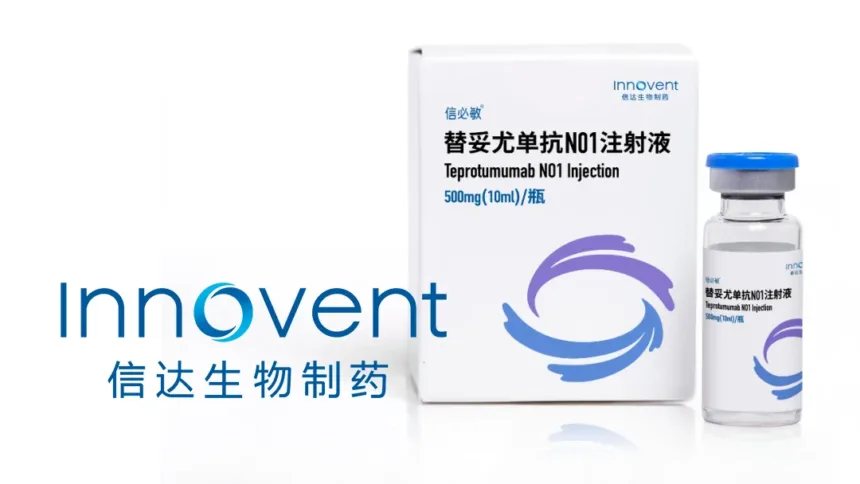
Innovent Biologics, Inc. (HKG: 1801) announced that Xinbimin (teprotumumab N01 Injection; development code: IBI311), its self-developed recombinant anti-insulin-like growth factor 1 receptor (IGF‑1R) antibody, has met the primary endpoint at Week 24 in RESTORE‑3, a multicenter, randomized, double-blind, placebo-controlled Phase III clinical study in Chinese participants with inactive Thyroid Eye Disease (TED). Xinbimin demonstrated significant efficacy in improving proptosis with a favorable safety profile, reinforcing the position of China’s first — and the world’s second — approved IGF‑1R antibody.
Clinical & Regulatory Milestone
| Item | Detail |
|---|---|
| Company | Innovent Biologics, Inc. (HKG: 1801) |
| Product | Xinbimin (teprotumumab N01 Injection; IBI311) – recombinant anti‑IGF‑1R antibody |
| Study | RESTORE‑3 – multicenter, randomized, double-blind, placebo-controlled Phase III |
| Population | Chinese participants with inactive Thyroid Eye Disease (TED) |
| Primary Endpoint | Proptosis response of the study eye at Week 24 — met |
| Key Result | Proptosis response rate 60.4% (IBI311) vs. 23.5% (placebo), p=0.0003 |
| Safety | Good safety and tolerability during double-blind treatment and follow-up |
| Approval History | First IGF‑1R antibody approved in China (second globally); NMPA approval March 2025 for TED |
| Reimbursement | Included in China’s National Reimbursement Drug List (NRDL) effective 1 Jan 2026 |
Drug Profile & Mechanism of Action
- Molecule: Xinbimin (IBI311), a self-developed recombinant monoclonal anti‑IGF‑1R antibody.
- Target: The insulin-like growth factor 1 receptor (IGF‑1R), which forms a signaling complex with the TSH receptor on orbital fibroblasts implicated in TED pathogenesis.
- Mechanism: Blocking IGF‑1R inhibits downstream inflammatory and tissue-remodeling signaling in the orbit, addressing proptosis and disease activity — the mechanism class first validated globally by teprotumumab.
- Class Position: First IGF‑1R antibody approved in China and the second worldwide, placing Innovent in an exclusive two-player global class.
- Regulatory Status: Approved by China’s National Medical Products Administration (NMPA) in March 2025 for thyroid eye disease; reimbursed nationally since 1 January 2026.
Clinical Evidence – Phase III RESTORE‑3 Trial
| Endpoint | Result (Xinbimin / IBI311) | Placebo | Statistical Significance |
|---|---|---|---|
| Proptosis Response Rate, Study Eye (Week 24) | 60.4% | 23.5% | p=0.0003 |
| Safety & Tolerability | Good safety and tolerability across double-blind treatment and follow-up periods | – | Favorable safety profile |
| Additional Endpoints / Sub-analyses | Not disclosed | – | – |
RESTORE‑3 was conducted as a multicenter, randomized, double-blind, placebo-controlled Phase III study in Chinese participants with inactive TED, with the primary endpoint evaluated at Week 24. The trial met its primary endpoint, showing a 36.9 percentage-point absolute improvement in proptosis response versus placebo. Participant numbers, site counts, and secondary endpoint details were not disclosed in the announcement.
Disease & Treatment Context – Inactive TED
- Thyroid Eye Disease: TED is an autoimmune orbital disease, most commonly associated with Graves’ disease, in which autoantibody-driven inflammation causes tissue expansion behind the eye, leading to proptosis (bulging eyes), diplopia, and in severe cases vision threat.
- Active vs. Inactive Disease: TED progresses through an active inflammatory phase followed by an inactive (fibrotic) phase; historically, management of inactive TED with residual proptosis has been dominated by surgical rehabilitation, with limited approved pharmacologic options specifically studied in this population.
- Significance of RESTORE‑3: Demonstrating significant proptosis improvement in inactive TED extends the evidence base for IGF‑1R blockade beyond the active-disease setting that anchored the class’s initial global approvals.
- China Access Landscape: With NRDL inclusion effective 1 January 2026, Xinbimin is reimbursed nationally, materially improving patient affordability and supporting commercial uptake across China’s large TED population.
Market Impact & Outlook
- First-Mover Position in China: As the first IGF‑1R antibody approved in China, Xinbimin currently defines the class in the Chinese market, now with reimbursement tailwinds from the NRDL.
- Label Expansion Potential: Positive RESTORE‑3 data in inactive TED may support broadening the evidence base for the product beyond its March 2025 approved indication scope; any regulatory application based on these data was not disclosed.
- Commercial Trajectory: NRDL coverage effective January 2026 positions the product for accelerated hospital access and volume growth; Innovent did not disclose sales figures or forecasts.
- Competitive Dynamics: Globally, the IGF‑1R antibody class remains a duopoly; future entrants, biosimilars, or alternative mechanisms (e.g., other orbital-targeted biologics) will shape long-term competition.
- Next Steps: Peer-reviewed publication of full RESTORE‑3 data and any subsequent regulatory or label discussions were not detailed in the announcement.
Forward‑Looking Statements
This brief contains forward‑looking statements regarding Xinbimin (IBI311), including the interpretation of RESTORE‑3 Phase III results, potential label and evidence-base expansion in inactive TED, and commercial uptake following NRDL inclusion. Actual results may differ due to risks including regulatory review outcomes, full-data maturation, reimbursement dynamics, competitive entry, and real-world safety experience.-Fineline Info & Tech