



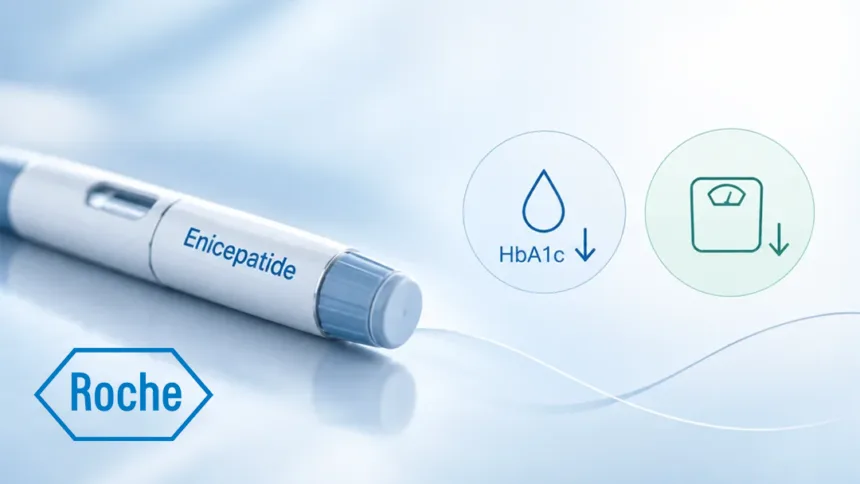
Roche Holding AG (SWX: ROP; OTCMKTS: RHHBY) announced positive topline results from CT‑388‑104, a Phase II clinical trial evaluating enicepatide (CT‑388) in adults living with type 2 diabetes (T2D) and overweight or obesity. The investigational once‑weekly subcutaneous injectable, a dually biased GLP‑1/GIP receptor agonist, met both primary endpoints, delivering dose‑dependent and clinically meaningful reductions in blood glucose and body weight at 48 weeks.
Trial Snapshot
| Item | Detail |
|---|---|
| Sponsor | Roche Holding AG (SWX: ROP; OTCMKTS: RHHBY) |
| Asset | Enicepatide (CT‑388) |
| Class | Dually biased GLP‑1/GIP receptor agonist |
| Administration | Once‑weekly subcutaneous injection |
| Study | CT‑388‑104 – Phase II |
| Design | Randomized, double‑blind, placebo‑controlled, parallel‑group, multi‑center |
| Population | Adults with type 2 diabetes and overweight or obesity |
| Duration | 48 weeks |
| Outcome | Both primary endpoints met (blood glucose and body weight reduction) |
| Announcement Date | 22 Sep 2026 |
Drug Profile & Mechanism of Action
- Molecule: Enicepatide (CT‑388), an investigational once‑weekly subcutaneous injectable peptide.
- Target: Dual agonism of the GLP‑1 (glucagon‑like peptide‑1) and GIP (glucose‑dependent insulinotropic polypeptide) receptors, with a dually biased signaling profile designed to engage both incretin pathways.
- Indications in Development: Obesity, type 2 diabetes, and additional cardiovascular indications.
- Mechanism Rationale: Dual incretin agonists combine glucose‑dependent insulin secretion, appetite regulation, and metabolic effects, the pharmacological foundation of the class that has redefined cardiometabolic medicine.
- Dosing Levels: Highest titrated dose of 24 mg; full dose‑ranging schema not disclosed in the topline release.
Clinical Evidence – Phase II Trial (CT‑388‑104)
| Endpoint | Result (Enicepatide 24 mg, Week 48) | Context | Relative Significance |
|---|---|---|---|
| HbA1c Reduction (Primary) | −2.65% from baseline HbA1c of 8.1% | Placebo‑controlled | Deep glycemic lowering, dose‑dependent |
| HbA1c ≤ 6.5% (T2D Diagnostic Threshold) | 90% of patients | – | Majority exited diabetic range |
| Normoglycemia (HbA1c < 5.7%) | 62% of patients | – | Blood glucose restored to non‑diabetic range |
| Body Weight Reduction (Primary) | −15.5% mean at 48 weeks | No demonstrable plateau | Suggests potential for further loss with extended treatment |
| Safety & Tolerability | Consistent with established incretin‑based therapies | – | No new safety signals reported |
The CT‑388‑104 study was conducted as a randomized, double‑blind, placebo‑controlled, parallel‑group, multi‑center Phase II trial. Enicepatide met both primary endpoints, with effects described as dose‑dependent and clinically meaningful across glycemic and weight outcomes. Sample size and lower‑dose cohort results were not disclosed in the topline announcement.
Market Impact & Outlook
- Cardiometabolic Landscape: The GLP‑1/GIP incretin class has become the most consequential therapeutic franchise in modern pharma, with obesity and type 2 diabetes representing one of the largest commercial opportunities in the sector; a validated dual agonist positions Roche to compete for share in this market.
- Differentiation Potential: The combination of a 2.65% HbA1c reduction, 62% of patients reaching normoglycemia, and 15.5% weight loss without plateau at 48 weeks places enicepatide’s topline profile within the range reported for leading approved incretin therapies, supporting its advancement case.
- Pipeline Expansion: Development plans extending into additional cardiovascular indications align with the class trajectory, where cardiorenal outcome evidence has become a key value driver.
- Next Steps: Timing of Phase III initiation, regulatory interactions, and head‑to‑head positioning versus established once‑weekly incretins were not disclosed in the announcement.
Forward‑Looking Statements
This brief contains forward‑looking statements regarding enicepatide’s clinical development, regulatory timeline, and commercial potential in obesity, type 2 diabetes, and cardiovascular indications. Actual results may differ due to risks including confirmatory trial outcomes, safety profile evolution, regulatory decisions, and competitive dynamics in the incretin class.-Fineline Info & Tech