


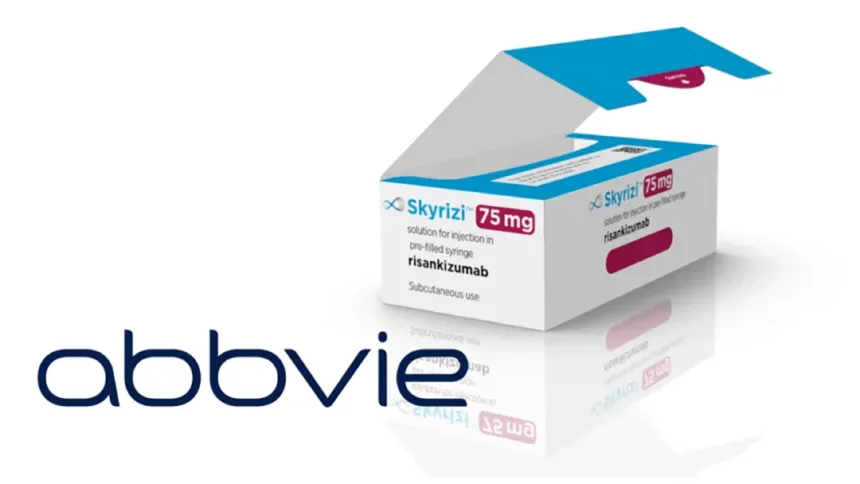
AbbVie (NYSE: ABBV) announced that the U.S. Food and Drug Administration (FDA) has approved a subcutaneous (SC) induction regimen for Skyrizi (risankizumab) for adults with moderately to severely active Crohn’s disease (CD) – giving patients the option to start SKYRIZI treatment at home, with induction doses delivered by an on‑body injector (OBI) induction pack.
Regulatory Milestone
| Item | Detail |
|---|---|
| Agency | U.S. FDA |
| Approval Type | New subcutaneous (SC) induction regimen |
| Product | Skyrizi (risankizumab) |
| Indication | Adults with moderately to severely active Crohn’s disease (CD) |
| Approval Date | 23 October 2026 (announcement) |
| Delivery Device | On‑body injector (OBI) induction pack; OBI continued once every eight weeks throughout maintenance |
| Patient Convenience | Induction therapy can now begin at home |
Drug Profile & Mechanism of Action
- Molecule: Risankizumab, an interleukin‑23 (IL‑23) inhibitor that blocks IL‑23 by selectively binding to its p19 subunit.
- Target Biology: IL‑23 is a cytokine involved in inflammatory processes and is thought to be linked to a number of chronic immune‑mediated diseases.
- Approved Indications (U.S. FDA): Moderately to severely active ulcerative colitis, plaque psoriasis, psoriatic arthritis, and Crohn’s disease – making SKYRIZI a broad‑label immunology franchise anchored in IL‑23 inhibition.
New Administration Pathway – At‑Home SC Induction
- Home Initiation: Patients can now start SKYRIZI treatment at home, removing the need for infusion‑center‑based induction and expanding access and convenience.
- OBI Induction Pack: Induction doses are delivered by an on‑body injector (OBI) induction pack – a wearable device designed for subcutaneous delivery of larger volumes.
- Seamless Maintenance Continuity: After induction, patients continue using an OBI once every eight weeks throughout the course of maintenance treatment – a single, consistent delivery modality across the entire treatment journey.
- Care Model Impact: The fully subcutaneous, device‑based pathway from induction through maintenance supports decentralized care and reduces healthcare‑system burden associated with infusion visits.
Market Impact & Outlook
- Crohn’s Disease Landscape: With the SC induction option, SKYRIZI strengthens its competitive position in moderately to severely active CD against both infusion‑dependent biologics and other IL‑23 competitors, offering a differentiated at‑home start‑of‑therapy experience.
- Franchise Expansion: The approval adds another administration modality to SKYRIZI’s already broad immunology label – spanning plaque psoriasis, psoriatic arthritis, ulcerative colitis, and now home‑initiated Crohn’s disease induction – reinforcing AbbVie’s key post‑Humira growth franchise.
- Adherence & Patient Preference: Once‑every‑eight‑week OBI maintenance following an at‑home induction offers a low‑burden dosing cadence that may improve adherence and patient satisfaction in chronic inflammatory bowel disease management.
- Device‑Enabled Differentiation: The integrated OBI induction‑to‑maintenance pathway sets a new convenience benchmark in IBD biologic therapy and underscores the growing strategic role of drug‑delivery devices in biologics competition.
Forward‑Looking Statements
This brief contains forward‑looking statements regarding the commercialization of the subcutaneous induction regimen for SKYRIZI (risankizumab) in Crohn’s disease, including market adoption, payer coverage, patient uptake of the on‑body injector, and further label or formulation expansions. Actual results may differ materially due to risks including competitive therapies, reimbursement dynamics, real‑world device performance and safety experience, and evolving treatment guidelines.-Fineline Info & Tech