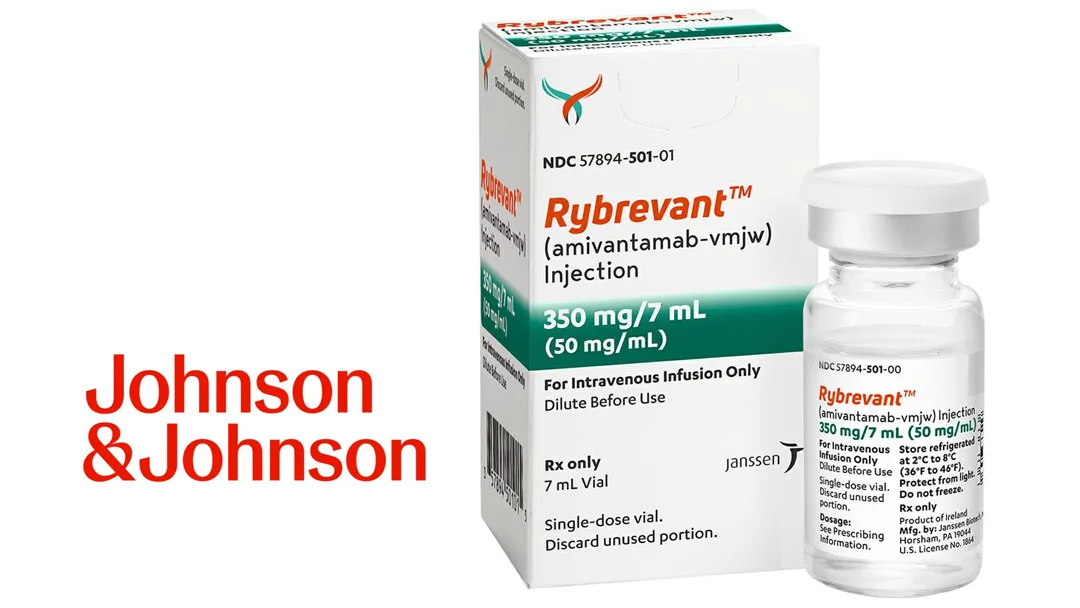
Johnson & Johnson (J&J, NYSE: JNJ) announced that the European Commission (EC) has approved an extension of the RYBREVANT (amivantamab) marketing authorization to include additional subcutaneous (SC) dosing regimens. The approval enables SC amivantamab use across all previously approved intravenous (IV) indications, offering reduced administration time from hours to minutes while maintaining comparable efficacy and safety.
Advanced NSCLC with EGFR exon 19 deletions or L858R mutations after prior EGFR TKI failure
Combination with carboplatin + pemetrexed
Advanced NSCLC with EGFR exon 20 insertions as first‑line treatment
Drug Profile – Amivantamab
Class:Fully‑human EGFR‑MET bispecific antibody
Mechanism: Dual‑targeting of EGFR and MET receptors to inhibit tumor growth and overcome resistance mutations
Administration Innovation:Subcutaneous delivery via Halozyme ENHANZE technology (rHuPH20) enables rapid dispersion and absorption
Clinical Benefit: SC administration reduces infusion time from hours to minutes, improving patient convenience and healthcare system efficiency
Clinical Evidence – PALOMA Studies
Study
Phase
Key Finding
PALOMA‑2
Phase 2
SC amivantamab demonstrates efficacy and safety consistent with IV formulation
PALOMA
Phase 1
SC route achieves comparable exposure with significantly reduced administration burden
Strategic Implications
Patient Experience: The SC expansion addresses a critical unmet need in NSCLC care—reducing clinic time burden for patients requiring chronic therapy, potentially improving adherence and quality of life.
Healthcare Efficiency:Minutes vs. hours administration enables higher patient throughput and reduced infusion center capacity constraints, particularly valuable in European healthcare systems.
Competitive Positioning: J&J strengthens its EGFR‑mutated NSCLC franchise by differentiating RYBREVANT through administration convenience, complementing the oral LAZCLUZE combination.
Technology Leverage: The ENHANZE partnership with Halozyme showcases J&J’s commitment to drug delivery innovation, with potential application to other pipeline biologics.
Market Impact
EU Market Expansion: EC approval unlocks subcutaneous access across all 27 EU member states, supporting RYBREVANT’s commercial growth in Europe’s competitive NSCLC market.
Revenue Synergies: The SC option may accelerate market share capture from IV‑only competitors by addressing physician and patient preference for convenient administration.
Global Precedent: The EU approval sets a regulatory pathway for potential U.S. FDA and other market submissions for SC amivantamab, expanding the addressable patient population globally.
Forward‑Looking Statements This brief contains forward‑looking statements regarding commercial uptake, regulatory expansions, and market share projections for SC amivantamab. Actual results may differ due to risks including reimbursement negotiations, competitive dynamics, and manufacturing supply.-Fineline Info & Tech
Insight, China's Pharmaceutical Industry Fineline Info & Tech is a comprehensive global pharmaceutical database that spans the entire product lifecycle. Its mission is to equip professionals and executives across all sectors of the life sciences industry with a standardized data language, offering a holistic view of the Chinese pharmaceutical competitive landscape. Flcube.com furnishes critical data essential for informed decision-making, drawing on global industry news, policy insights, competitive intelligence, and advanced analytical tools.