



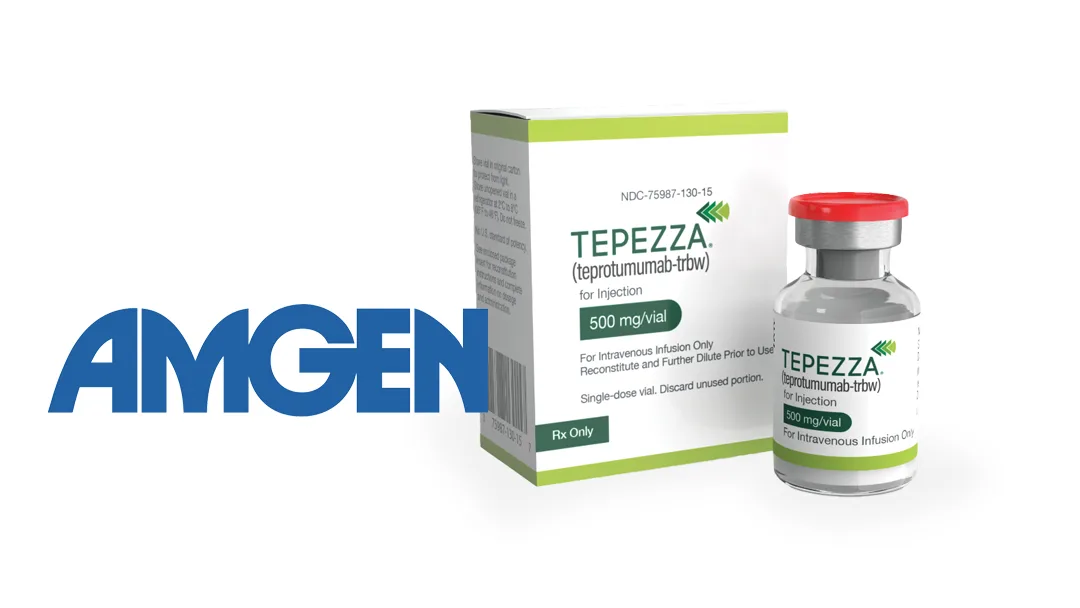
Amgen Inc. (NASDAQ: AMGN) announced positive top-line results from a Phase III clinical trial evaluating Tepezza® (teprotumumab) administered subcutaneously via an on-body injector (OBI) in patients with moderately-to-severely active thyroid eye disease (TED). The subcutaneous formulation demonstrated non-inferior efficacy to the established intravenous (IV) regimen, achieving a statistically significant and clinically meaningful proptosis response rate of 77% (P < 0.0001) at Week 24 versus placebo.
The study also met its key secondary endpoint, with a mean proptosis reduction of –3.17 mm (P < 0.0001), reinforcing Tepezza’s role as the first and only approved immunotherapy targeting the insulin-like growth factor-1 receptor (IGF-1R) in TED—a rare, vision-threatening autoimmune disorder affecting orbital tissues.
Clinical Trial Highlights
| Endpoint | Tepezza OBI Result | P-Value | Clinical Significance |
|---|---|---|---|
| Primary: Proptosis Response Rate (≥2 mm reduction in both eyes) | 77% | < 0.0001 | Clinically meaningful improvement in eye bulging |
| Key Secondary: Mean Proptosis Reduction | –3.17 mm | < 0.0001 | Exceeds minimal clinically important difference (MCID ≈ –2 mm) |
| Safety Profile | Consistent with IV formulation; no new safety signals | — | Most common AEs: transient hyperglycemia, muscle spasm, alopecia |
Disease & Therapeutic Context
- Thyroid Eye Disease (TED): A progressive autoimmune condition driven by autoantibodies activating IGF-1R on orbital fibroblasts, leading to inflammation, fat expansion, and proptosis. Occurs primarily in Graves’ disease patients but is a distinct pathological entity.
- Unmet Need: Prior to Tepezza, treatment options were limited to corticosteroids, orbital radiation, or invasive surgery—none targeting the underlying molecular mechanism.
- Tepezza Milestones:
- US FDA Approval: January 2020 (IV formulation)
- EU Marketing Authorization: June 2025
- UK MHRA Approval: July 2025
- Innovation: The OBI delivery system enables at-home administration, reducing clinic visits and improving patient convenience while maintaining therapeutic equivalence.
Commercial & Strategic Outlook
- Market Position: Tepezza generated $2.1 billion in global sales in 2025, with TED prevalence estimated at 16–19 cases per 100,000 adults in the US and EU.
- Differentiation: Remains the only IGF-1R–targeted therapy approved for TED; no biosimilars or direct competitors expected before 2030.
- Next Steps: Amgen plans to submit regulatory filings for the OBI formulation in the US, EU, and UK in H2 2026, supported by this pivotal data.
- Patient Impact: Subcutaneous delivery could expand access in rural or underserved regions and improve long-term adherence.
Forward-Looking Statements
This brief contains forward-looking statements regarding regulatory submissions, market potential, and clinical development. Actual outcomes may differ due to regulatory decisions, competitive developments, and clinical adoption trends.-Fineline Info & Tech