 By Fineline Cube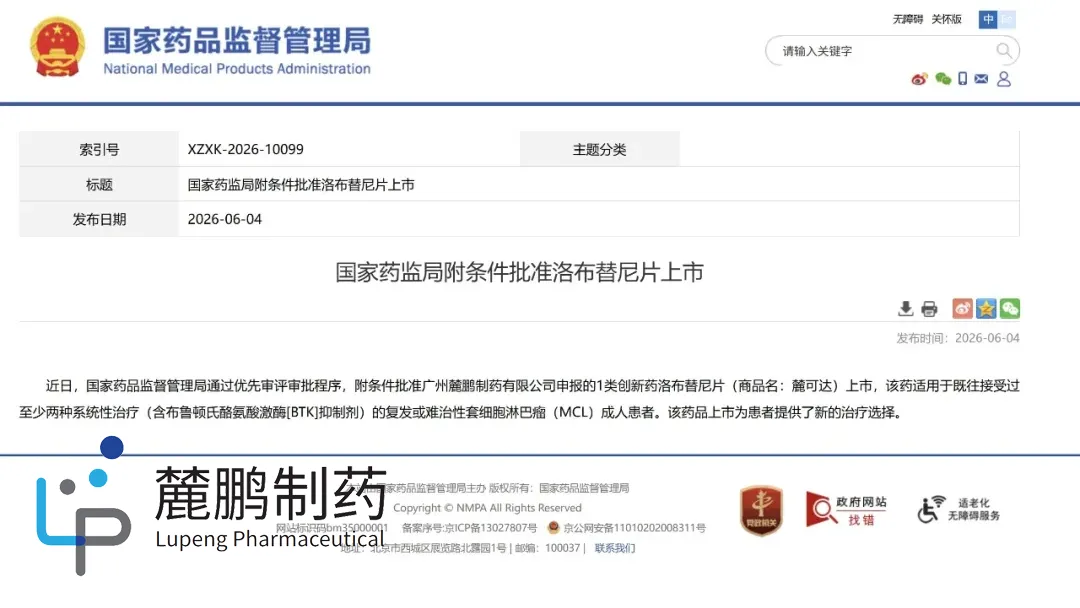
Guangzhou Lupeng Pharmaceutical Co., Ltd. announced it has received marketing approval via priority review pathway from China’s National Medical Products Administration (NMPA) for rocbrutinib, a fourth-generation Bruton’s tyrosine kinase (BTK) inhibitor, for the treatment of adult patients with relapsed or refractory mantle cell lymphoma (R/R MCL) who have received at least two prior systemic therapies, including BTK inhibitors.
Regulatory Milestone
| Item | Detail |
|---|---|
| Company | Guangzhou Lupeng Pharmaceutical Co., Ltd. |
| Regulatory Agency | NMPA (China) |
| Approval Type | Marketing approval via priority review pathway |
| Indication | Relapsed or refractory mantle cell lymphoma (R/R MCL) |
| Patient Population | Adults with ≥2 prior systemic therapies (including BTK inhibitors) |
| Supporting Study | Phase III ROCK-1 trial – national multi-center, open-label, single-arm |
| Drug Classification | Fourth-generation BTK inhibitor |
Clinical Trial Results – ROCK-1 Study
| Efficacy Endpoint | Result |
|---|---|
| Objective Response Rate (ORR) | 63.9% |
| Complete Response Rate (CR) | 23% |
| Median Duration of Response (mDOR) | 16.5 months |
| Data Cutoff | June 5, 2025 |
| Patient Population | R/R MCL previously treated with covalent BTK inhibitors |
Safety Profile Highlights
- Cardiac Safety: Zero cases of atrial fibrillation or atrial flutter (any grade)
- Treatment Discontinuation: No patients discontinued due to adverse reactions
- Overall Tolerability: Low incidence of other adverse reactions, all manageable
- Differentiation: Superior cardiac safety profile compared to earlier-generation BTK inhibitors
Market Context & Competitive Landscape
| MCL Treatment Challenge | Rocbrutinib Solution |
|---|---|
| BTK Inhibitor Resistance | ~50-60% of MCL patients develop resistance to first/second-generation BTKis Limited effective options post-BTKi failure |
| Cardiac Toxicity | Atrial fibrillation rates of 5-15% with ibrutinib Significant cause of treatment discontinuation |
| Response Durability | Short duration of response with salvage therapies post-BTKi failure |
Commercial Opportunity Analysis
- Patient Population: Approximately 3,000-4,000 R/R MCL patients annually in China requiring third-line therapy
- Pricing Premium: Fourth-generation status and superior safety profile support premium pricing
- Market Access: Priority review approval accelerates reimbursement negotiations and hospital formulary inclusion
- Revenue Potential: Peak annual sales projected at $150-250 million in China alone
- Global Expansion: Strong clinical data supports potential international regulatory filings
Strategic Implications for Guangzhou Lupeng
- Pipeline Leadership: Establishes Guangzhou Lupeng as innovator in hematologic malignancies
- BTK Platform Validation: Demonstrates successful progression from discovery through regulatory approval
- Commercial Infrastructure: Leverages existing oncology commercial capabilities in Chinese market
- Competitive Positioning: Differentiates from established players like Johnson & Johnson (ibrutinib) and AstraZeneca (acalabrutinib)
- Investor Confidence: First major product approval validates company’s drug development strategy
Forward‑Looking Statements
This brief contains forward‑looking statements regarding regulatory approvals, clinical outcomes, and commercial expectations for rocbrutinib. Actual results may differ due to risks including market adoption, competitive dynamics, and reimbursement decisions.-Fineline Info & Tech