



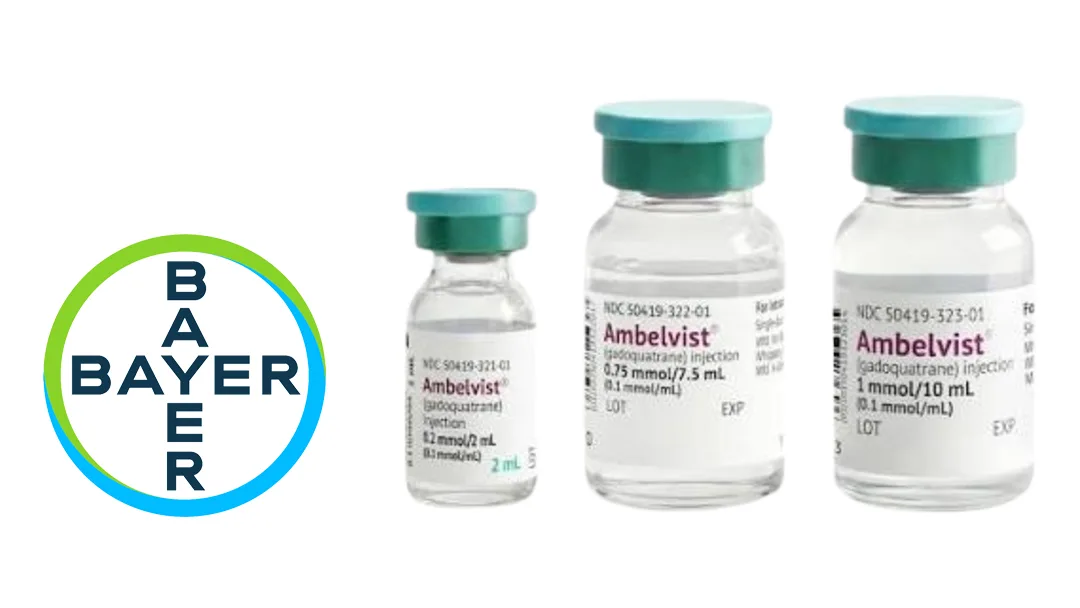
Bayer AG (ETR: BAYN) announced that the U.S. Food and Drug Administration (FDA) has granted approval for Ambelvist (gadoquatrane), a novel intravenous macrocyclic gadolinium-based contrast agent (mGBCA), for use in adult and pediatric patients (including full-term neonates) undergoing contrast-enhanced magnetic resonance imaging (MRI) to detect and visualize lesions with vascular abnormalities in both the central nervous system (CNS) and non-CNS body regions.
Regulatory Milestone
| Item | Detail |
|---|---|
| Agency | FDA (United States) |
| Approval Type | New Drug Application (NDA) |
| Product | Ambelvist (gadoquatrane) – tetrameric mGBCA with high relaxivity |
| Indication | Detection and visualization of vascular abnormality lesions in CNS and body regions |
| Patient Population | Adults and pediatric patients including full-term neonates |
| Approval Date | 16 Jun 2026 |
Drug Profile & Mechanism of Action
- Molecule: Gadoquatrane – novel tetrameric macrocyclic gadolinium-based contrast agent
- Key Innovation: Unique tetrameric structure providing high relaxivity (superior signal enhancement)
- Dosing Advantage: Effective at 0.01 mmol/kg (0.04 mmol Gd/kg) – significantly lower gadolinium exposure compared to standard agents
- Safety Profile: Macrocyclic structure associated with enhanced stability and reduced risk of gadolinium retention
Clinical Evidence – Phase III QUANTI Study
| Endpoint | Ambelvist (0.04 mmol Gd/kg) | Standard mGBCAs (0.1 mmol Gd/kg) | Outcome |
|---|---|---|---|
| Lesion Visualization Score | Comparable | Reference | Non-inferior |
| Number of Identified Lesions | Comparable | Reference | Non-inferior |
| Superiority vs Pre-contrast MRI | Significant improvement | N/A | Met primary endpoint |
| Pediatric Safety | Established across all age groups including neonates | N/A | Comprehensive data package |
The pivotal QUANTI study demonstrated that Ambelvist enables superior lesion visualization compared to unenhanced MRI while using a substantially lower gadolinium dose, addressing growing concerns about gadolinium retention in patients requiring repeated contrast-enhanced imaging.
Market Impact & Strategic Significance
- Addressable Market: Over 35 million contrast-enhanced MRI procedures performed annually in the US alone, with approximately 40% using gadolinium-based agents
- Competitive Differentiation: Ambelvist’s high relaxivity allows for lower dosing while maintaining diagnostic efficacy, potentially reducing long-term gadolinium accumulation risks
- Pediatric Expansion: First mGBCA with comprehensive safety and efficacy data spanning from full-term neonates through adults, opening significant opportunities in pediatric radiology
- Revenue Potential: Analysts project peak annual sales of €400–600 million globally by 2030, assuming 15–20% market share capture in the premium mGBCA segment
Bayer’s approval of Ambelvist reinforces its leadership position in diagnostic imaging and demonstrates its commitment to developing innovative contrast agents that enhance diagnostic accuracy while prioritizing patient safety through reduced metal exposure.
Forward‑Looking Statements
This brief contains forward-looking statements regarding regulatory approvals, clinical outcomes, and commercial expectations for Ambelvist (gadoquatrane). Actual results may differ due to risks including market adoption, competitive dynamics, reimbursement decisions, and execution of Bayer’s commercial strategy.-Fineline Info & Tech