


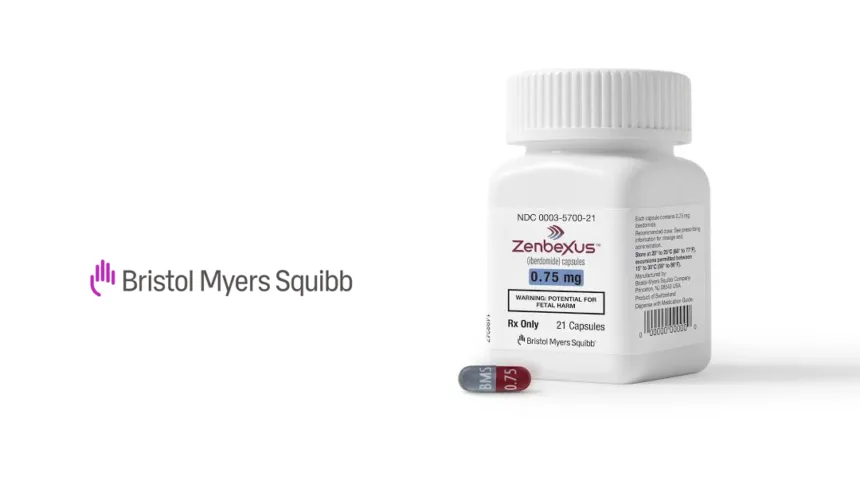
Bristol‑Myers Squibb Co. (BMS, NYSE: BMY) announced that China’s National Medical Products Administration (NMPA) has granted conditional marketing approval for Zenbexus® (iberdomide), the world’s first oral CELMoD® (Cereblon E3 Ligase Modulator) agent, in combination with daratumumab and dexamethasone (IberDd regimen), for the treatment of adult patients with multiple myeloma who have received at least one prior line of therapy (including a proteasome inhibitor and an immunomodulatory agent). The approval is based on the Phase III EXCALIBER‑RRMM study, which demonstrated a statistically significant improvement in MRD‑negative complete response (CR) rates — marking the first regulatory approval in the relapsed/refractory multiple myeloma (RRMM) field based on MRD‑negative CR data.
Regulatory Milestone
| Item | Detail |
|---|---|
| Agency | NMPA (China) |
| Approval Type | Conditional marketing approval |
| Product | Zenbexus® (iberdomide), oral CELMoD® agent |
| Approved Regimen | Iberdomide + daratumumab + dexamethasone (IberDd) |
| Indication | Adult patients with multiple myeloma who have received ≥1 prior line of therapy (including a proteasome inhibitor and an immunomodulatory agent) |
| Pivotal Study | EXCALIBER‑RRMM (Phase III) |
| Regulatory Significance | First RRMM approval globally based on MRD‑negative CR endpoint |
| Approval Date | 30 September 2026 |
| Next Steps | Fulfillment of conditional approval requirements per NMPA regulations |
Drug Profile & Mechanism of Action
- Molecule: Iberdomide (brand name: Zenbexus®), a novel oral small‑molecule CELMoD® agent.
- Drug Class: Cereblon E3 Ligase Modulator (CELMoD®) — a new pharmacological category distinct from traditional immunomodulatory drugs (IMiDs®) such as lenalidomide and pomalidomide.
- Mechanism: Iberdomide’s mechanism is rooted in the Nobel Prize‑winning principle of ubiquitin‑mediated proteasomal degradation. It binds to cereblon, a substrate receptor of the CRL4 E3 ubiquitin ligase complex, inducing targeted degradation of specific neo‑substrates (including transcription factors Ikaros and Aiolos) that drive multiple myeloma cell survival and immune evasion.
- Differentiation from Legacy IMiDs:
- Higher binding affinity for cereblon compared to lenalidomide and pomalidomide
- Broader and deeper substrate degradation profile
- Optimized pharmacokinetic properties as an oral agent
- Intellectual Property: Proprietary CELMoD® platform developed by Bristol‑Myers Squibb (originally by Celgene, acquired by BMS in 2019).
Clinical Evidence – EXCALIBER‑RRMM Phase III Study
The EXCALIBER‑RRMM study evaluated the IberDd regimen (iberdomide + daratumumab + dexamethasone) versus a comparator regimen in patients with early‑line relapsed or refractory multiple myeloma (RRMM).
| Endpoint | IberDd Regimen | Comparator | Statistical Significance |
|---|---|---|---|
| 16‑Month MRD‑Negative CR Rate | 41% | 21% | p < 0.0001 |
| Relative Improvement | — | — | ~95% relative increase |
Safety Profile:
| Parameter | Result |
|---|---|
| Overall Safety | Consistent with known profiles of individual regimen components |
| Discontinuation Rate (Adverse Reactions) | 7.8% |
| Safety Conclusion | Manageable and acceptable safety profile for the RRMM population |
Significance of MRD‑Negative CR as an Endpoint
- Minimal Residual Disease (MRD) negativity has emerged as the most sensitive prognostic biomarker in multiple myeloma, with MRD‑negative status correlating with significantly longer progression‑free survival (PFS) and overall survival (OS).
- MRD‑negative CR — the combination of complete response by conventional criteria and MRD negativity by sensitive detection methods (e.g., next‑generation flow cytometry or sequencing at 10⁻⁵ sensitivity) — is increasingly recognized by regulatory agencies as a surrogate endpoint for accelerated and conditional approvals in hematologic malignancies.
- The EXCALIBER‑RRMM study represents the first successful use of MRD‑negative CR as the primary basis for regulatory approval in RRMM, establishing a potential regulatory precedent for future multiple myeloma drug development.
Market Impact & Outlook
- China Multiple Myeloma Landscape: China has an estimated ~100,000+ prevalent multiple myeloma cases, with incidence rising due to population aging. The RRMM treatment market is rapidly evolving as patients survive longer through sequential lines of therapy, creating demand for novel mechanisms beyond the standard IMiD–proteasome inhibitor–anti‑CD38 paradigm.
- CELMoD® as a New Drug Class: Iberdomide’s approval establishes CELMoD® agents as a distinct pharmacological class in China’s multiple myeloma treatment armamentarium — differentiated from legacy IMiDs (lenalidomide, pomalidomide, thalidomide) by their enhanced cereblon engagement and substrate degradation profiles. This positions BMS to capture premium pricing as a first‑in‑class oral therapy.
- MRD‑Driven Regulatory Paradigm: As the first RRMM approval based on MRD‑negative CR data, this milestone may accelerate the adoption of MRD‑guided treatment strategies in Chinese clinical practice and influence future NMPA guidance on multiple myeloma drug development endpoints.
- IberDd Regimen – Combination Synergy: The combination of iberdomide with daratumumab (an anti‑CD38 monoclonal antibody, marketed as Darzalex®/兆珂® by Johnson & Johnson) leverages complementary mechanisms — CELMoD‑mediated immune modulation and direct tumor cell killing via ADCC/CDC — creating a chemotherapy‑free, all‑oral‑plus‑subcutaneous regimen that avoids the toxicity of traditional cytotoxic agents.
- BMS Myeloma Franchise in China: This approval strengthens BMS’s competitive position in China’s multiple myeloma market, complementing its existing portfolio. BMS is a global leader in myeloma therapeutics through its IMiD® heritage (Revlimid®, Pomalyst®) and CELMoD® pipeline.
- Conditional Approval Pathway: The conditional approval mechanism enables earlier patient access while requiring post‑marketing commitments (e.g., confirmatory studies, additional safety monitoring). BMS will need to fulfill NMPA‑specified conditions to convert to a standard marketing approval — a pathway increasingly used in China for oncology drugs addressing significant unmet needs.
- Global Implications: While this approval is specific to China, the EXCALIBER‑RRMM data package and MRD‑negative CR precedent may inform regulatory submissions in other jurisdictions, including potential discussions with the U.S. FDA and EMA on MRD‑based accelerated approval pathways for iberdomide combinations.
- Competitive Landscape: Iberdomide enters a China RRMM market that includes daratumumab‑based combinations, carfilzomib‑based regimens, selinexor, BCMA‑targeted CAR‑T therapies (e.g., ciltacabtagene autoleucel), and emerging bispecific antibodies. The IberDd regimen’s oral convenience, manageable safety (7.8% discontinuation), and deep MRD responses position it as a differentiated option in the early‑relapse setting.
Forward‑Looking Statements
This brief contains forward‑looking statements regarding regulatory timelines, post‑marketing commitments, commercialization expectations, and the potential global regulatory implications of iberdomide’s conditional NMPA approval. Actual results may differ materially due to risks including the fulfillment of conditional approval requirements, confirmatory study outcomes, market adoption dynamics, competitive pressures in the China multiple myeloma market, pricing and reimbursement negotiations, manufacturing and supply chain execution, and regulatory decisions in other jurisdictions. Investors are advised to exercise caution.-Fineline Info & Tech