


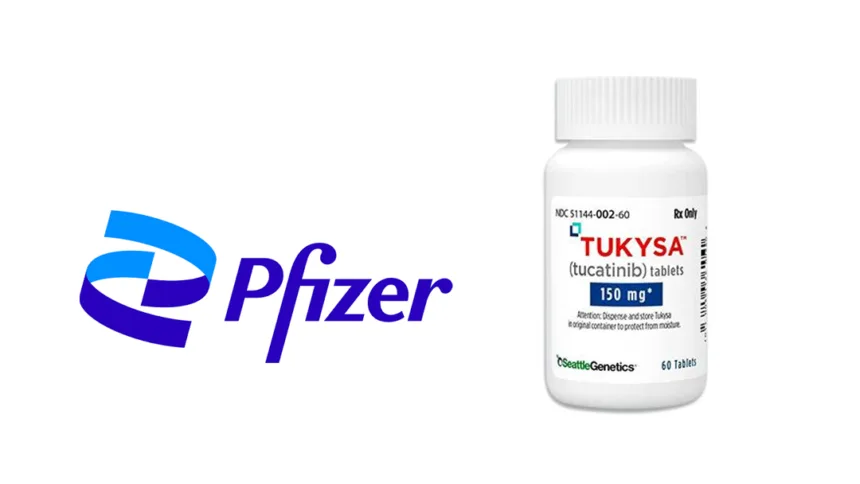
Pfizer Inc. (NYSE: PFE) announced that the U.S. Food and Drug Administration (FDA) has approved TUKYSA® (tucatinib) in combination with trastuzumab and pertuzumab for the maintenance treatment of adults with unresectable locally advanced or metastatic HER2‑positive (HER2+) breast cancer following induction treatment. This new approval expands tucatinib’s use into the first‑line maintenance setting, offering a chemotherapy‑free treatment option that demonstrated a 35.9% reduction in the risk of disease progression or death in the pivotal Phase 3 HER2CLIMB‑05 trial.
Regulatory Milestone
| Item | Detail |
|---|---|
| Agency | U.S. Food and Drug Administration (FDA) |
| Approval Type | New indication expansion |
| Product | TUKYSA® (tucatinib) |
| Approved Regimen | Tucatinib + trastuzumab + pertuzumab |
| Indication | Maintenance treatment of adults with unresectable locally advanced or metastatic HER2+ breast cancer following induction treatment |
| Line of Therapy | First‑line maintenance (post‑induction) |
| Pivotal Study | HER2CLIMB‑05 (Phase 3) |
| Prior Approved Indication | In combination with trastuzumab and capecitabine for HER2+ advanced/MBC (including brain metastases) after ≥1 prior anti‑HER2 regimen |
| Approval Date | 7 October 2026 |
Drug Profile & Mechanism of Action
- Molecule: Tucatinib (brand name: TUKYSA®), a highly selective, orally administered tyrosine kinase inhibitor (TKI) of HER2.
- Developer: Originally developed by Seattle Genetics (now Seagen, acquired by Pfizer in December 2023 for US$43 billion).
- Mechanism: Tucatinib is a small‑molecule TKI that selectively inhibits the HER2 tyrosine kinase without significant inhibition of EGFR (HER1) — a distinguishing feature from earlier‑generation pan‑HER TKIs (e.g., lapatinib, neratinib). This selectivity reduces EGFR‑related toxicities (skin rash, diarrhea) while maintaining potent anti‑HER2 activity.
- Key Differentiators:
- Oral administration — enables outpatient maintenance therapy without IV infusion
- High HER2 selectivity — minimizes off‑target EGFR toxicity
- CNS penetration — demonstrated activity in brain metastases, a significant unmet need in HER2+ MBC (the prior approved indication)
- Formulation: Oral tablet
Clinical Evidence – HER2CLIMB‑05 Phase 3 Trial
The HER2CLIMB‑05 trial evaluated tucatinib + trastuzumab + pertuzumab versus placebo + trastuzumab + pertuzumab as maintenance therapy following induction treatment in patients with unresectable locally advanced or metastatic HER2+ breast cancer.
| Endpoint | Tucatinib + Trastuzumab + Pertuzumab | Placebo + Trastuzumab + Pertuzumab | Result |
|---|---|---|---|
| Median PFS (Investigator‑Assessed) | 24.9 months | 16.3 months | HR = 0.641 |
| Risk Reduction (Progression or Death) | — | — | 35.9% reduction |
Safety Profile:
| Parameter | Observation |
|---|---|
| Overall Safety | Generally consistent with known tucatinib safety profile |
| Notable Finding | Increased severity of hepatotoxicity observed in the maintenance setting |
| Management | Hepatic function monitoring recommended per prescribing information |
Clinical Significance of HER2CLIMB‑05 Results
- Chemotherapy‑Free Maintenance: The approved regimen provides a chemotherapy‑free maintenance option — a significant quality‑of‑life advantage for patients who have completed induction chemotherapy and wish to minimize cumulative toxicity during long‑term disease control.
- 24.9‑Month Median PFS: The median PFS of 24.9 months in the tucatinib arm represents a clinically meaningful extension of disease control in the first‑line maintenance setting, where patients are typically treatment‑naïve or minimally pretreated.
- Dual Anti‑HER2 Antibody Backbone: The combination with both trastuzumab and pertuzumab — the standard dual‑antibody backbone established in the CLEOPATRA trial — ensures continuity of established anti‑HER2 therapy while adding tucatinib’s complementary TKI mechanism.
Market Impact & Outlook
- HER2+ Metastatic Breast Cancer Landscape: HER2+ breast cancer accounts for approximately ~15–20% of all breast cancers, translating to ~50,000–60,000 new metastatic cases annually in the U.S. alone. The first‑line maintenance setting is a high‑volume, high‑duration treatment phase where patients remain on therapy for extended periods, creating substantial commercial opportunity.
- Chemotherapy‑Free Paradigm Shift: The approval of a chemotherapy‑free, oral TKI + dual antibody maintenance regimen represents a potential paradigm shift in first‑line HER2+ MBC management. Current standard maintenance typically involves continuation of trastuzumab ± pertuzumab after induction chemotherapy; the addition of tucatinib offers a mechanistically distinct, oral complement that may improve long‑term adherence and tolerability.
- Pfizer/Seagen HER2 Franchise Integration: TUKYSA joins Pfizer’s growing HER2 oncology portfolio following the US$43 billion Seagen acquisition (December 2023), which also brought Padcev® (enfortumab vedotin) and other antibody‑drug conjugates into the Pfizer fold. The first‑line maintenance approval expands TUKYSA’s addressable market from the later‑line setting (post‑capecitabine, post‑brain metastases) to the much larger first‑line maintenance population.
- Brain Metastasis Data as Long‑Term Differentiator: While the current approval is for maintenance therapy, tucatinib’s established activity in brain metastases (from the HER2CLIMB trial) provides a unique positioning narrative — physicians may preferentially select tucatinib‑based maintenance for patients at higher risk of CNS progression, a subgroup representing ~30–50% of HER2+ MBC patients over the course of their disease.
- Hepatotoxicity Signal – Monitoring Required: The observed increased severity of hepatotoxicity in the maintenance setting warrants attention and will require proactive hepatic function monitoring in clinical practice. However, the overall safety profile remained manageable, and the efficacy benefit (35.9% risk reduction) is likely to outweigh this concern for most patients and prescribers.
- Competitive Landscape: TUKYSA’s first‑line maintenance approval competes with:
- Standard dual antibody maintenance (trastuzumab + pertuzumab alone)
- T‑DXd (Enhertu®) — Daiichi Sankyo/AstraZeneca’s HER2 ADC, which has demonstrated remarkable efficacy in later‑line HER2+ MBC and is being explored in earlier settings
- Other HER2 TKIs (lapatinib, neratinib) — which have not achieved the same level of HER2 selectivity or CNS activity as tucatinib
- Pricing and Reimbursement: As a Pfizer‑marketed oral oncology product, TUKYSA benefits from the company’s established oncology commercial infrastructure and payer relationships. The maintenance setting’s extended treatment duration creates favorable lifetime value per patient economics.
- Label Expansion Strategy: This approval represents a front‑of‑label migration for tucatinib — moving from the later‑line, post‑progression setting to the first‑line maintenance setting — a strategy that maximizes the drug’s commercial potential by capturing patients earlier in their treatment journey.
Forward‑Looking Statements
This brief contains forward‑looking statements regarding the commercial potential of TUKYSA in the first‑line maintenance setting, market adoption dynamics, and competitive positioning in HER2+ metastatic breast cancer. Actual results may differ materially due to risks including market adoption and physician prescribing preferences, competitive dynamics (particularly from HER2 ADCs such as T‑DXd), hepatotoxicity management in clinical practice, pricing and reimbursement negotiations, and the ability to differentiate TUKYSA from established dual antibody maintenance regimens. Investors are advised to exercise caution.-Fineline Info & Tech