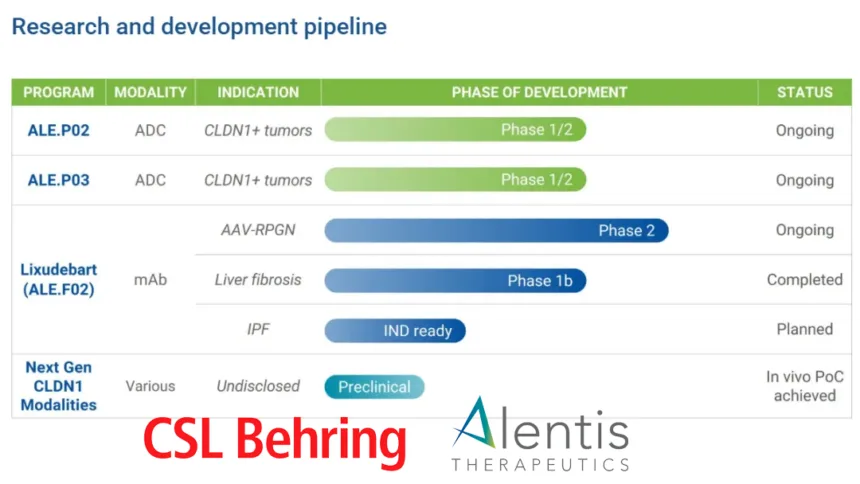
CSL Behring, a subsidiary of CSL Limited (ASX: CSL), and Alentis Therapeutics announced an exclusive global collaboration agreement to co‑develop and co‑promote lixudebart (formerly ALE.F02), an investigational monoclonal antibody that selectively targets exposed claudin‑1 — a novel mechanism with potent anti‑inflammatory and anti‑fibrotic effects. The transaction is anchored by a US$355 million upfront payment to Alentis, with up to an additional US$1.2 billion in commercial milestone payments, bringing the total potential deal value to approximately US$1.555 billion, alongside a 55/45 global profit‑sharing arrangement.
CSL fully funds Phase 2 RENAL trial, planned Phase 3 in AAV‑RPGN, Phase 2 trials in FSGS and PSC, and supporting development activities
Profit Share (Post‑Commercialization)
55% CSL / 45% Alentis (global)
Territory
Global
Announcement Date
5 October 2026
Drug Profile & Mechanism of Action
Molecule: Lixudebart, an investigational monoclonal antibody that selectively targets exposed claudin‑1 — a tight‑junction protein normally sequestered between cells but aberrantly exposed on the surface of damaged or inflamed epithelial and endothelial cells.
Developer: Originally developed by Alentis Therapeutics; now jointly advanced under the CSL–Alentis collaboration.
Mechanism: By selectively binding exposed claudin‑1, lixudebart exerts dual anti‑inflammatory and anti‑fibrotic effects, with the potential to prevent and reverse organ damage — a mechanism distinct from conventional immunosuppressants and biologics that broadly suppress immune function.
Therapeutic Breadth: The claudin‑1 target is implicated across kidney, liver, and lung diseases, providing a multi‑indication platform beyond the initial development programs.
Innovation: First‑in‑class mechanism targeting exposed claudin‑1; represents a paradigm shift from broad immunosuppression to tissue‑selective intervention at the site of epithelial/endothelial injury.
Clinical Development Programs
1. ANCA‑Associated Vasculitis with Rapidly Progressive Glomerulonephritis (AAV‑RPGN)
Item
Detail
Indication
AAV‑RPGN — a rare, potentially life‑threatening autoimmune disease causing irreversible kidney damage and end‑stage renal disease
Current Stage
Phase 2 (RENAL trial — ongoing)
Trial Design
Evaluating lixudebart in patients with ANCA‑associated vasculitis with rapidly progressive glomerulonephritis
Next Step
Planned Phase 3 trial (fully funded by CSL under the agreement)
Unmet Need
Current standard of care (cyclophosphamide, rituximab + glucocorticoids) carries significant toxicity; relapse rates remain high; renal function decline is often irreversible
2. Focal Segmental Glomerulosclerosis (FSGS)
Item
Detail
Indication
FSGS — a leading cause of nephrotic syndrome and progressive kidney failure
Current Stage
Phase 2 (planned)
Unmet Need
Limited approved therapies; many patients progress to end‑stage renal disease despite current treatments
3. Primary Sclerosing Cholangitis (PSC)
Item
Detail
Indication
PSC — a progressive, cholestatic liver disease with no approved pharmacotherapy
Current Stage
Phase 2 (planned)
Unmet Need
No approved drug therapy; patients face progressive bile duct destruction, cirrhosis, and liver transplantation as the only definitive treatment
Market Impact & Outlook
AAV‑RPGN – Rare Disease Premium: ANCA‑associated vasculitis is a rare autoimmune disease with an estimated incidence of ~20–40 cases per million per year in developed markets. RPGN represents the most aggressive renal manifestation, where rapid intervention is critical. A targeted anti‑fibrotic/anti‑inflammatory biologic that can preserve renal function and reduce relapse would command premium pricing and rapid specialist uptake.
FSGS – Large Unmet Need: FSGS affects an estimated ~50,000–100,000 patients in the U.S. and Europe combined, with significant progression to end‑stage renal disease. The absence of broadly effective approved therapies creates a substantial opportunity for a novel mechanism.
PSC – Whitespace Market: With no approved pharmacotherapy globally, PSC represents a pure unmet‑need opportunity. The anti‑fibrotic mechanism of lixudebart is mechanistically rational for a disease driven by progressive biliary fibrosis.
CSL’s Strategic Fit: The deal significantly bolsters CSL Behring’s rare disease and immunology franchise, adding a multi‑indication platform asset to complement its established portfolio in hematology, immunology, and rare diseases. The 55/45 profit share gives CSL majority economics while preserving Alentis’s incentive to co‑develop.
Alentis De‑Risking: The US$355 million upfront provides Alentis with substantial non‑dilutive capital, fully de‑risking the Phase 2 and Phase 3 development of its lead asset while retaining meaningful upside through milestones and profit participation.
Platform Upside: The exposed claudin‑1 target’s relevance across kidney, liver, and lung diseases creates significant pipeline expansion potential beyond the three initially disclosed indications — potentially including idiopathic pulmonary fibrosis (IPF), other glomerulopathies, and additional cholangiopathies.
Competitive Differentiation: Lixudebart’s tissue‑selective mechanism — targeting exposed claudin‑1 at sites of epithelial injury rather than broadly suppressing immune function — may offer a superior safety profile compared to conventional immunosuppressants, a critical consideration for chronic rare disease populations requiring long‑term therapy.
Forward‑Looking Statements This brief contains forward‑looking statements regarding clinical development plans, regulatory timelines, and commercial expectations for lixudebart. Actual results may differ materially due to risks including Phase 2 RENAL trial outcomes, Phase 3 trial design and execution, regulatory review timelines across multiple jurisdictions and indications, competitive dynamics, manufacturing scale‑up, market access and reimbursement negotiations, and the inherent uncertainties of biological drug development. Lixudebart may not receive marketing approval in any jurisdiction. Investors are advised to exercise caution.-Fineline Info & Tech
Insight, China's Pharmaceutical Industry Fineline Info & Tech is a comprehensive global pharmaceutical database that spans the entire product lifecycle. Its mission is to equip professionals and executives across all sectors of the life sciences industry with a standardized data language, offering a holistic view of the Chinese pharmaceutical competitive landscape. Flcube.com furnishes critical data essential for informed decision-making, drawing on global industry news, policy insights, competitive intelligence, and advanced analytical tools.