


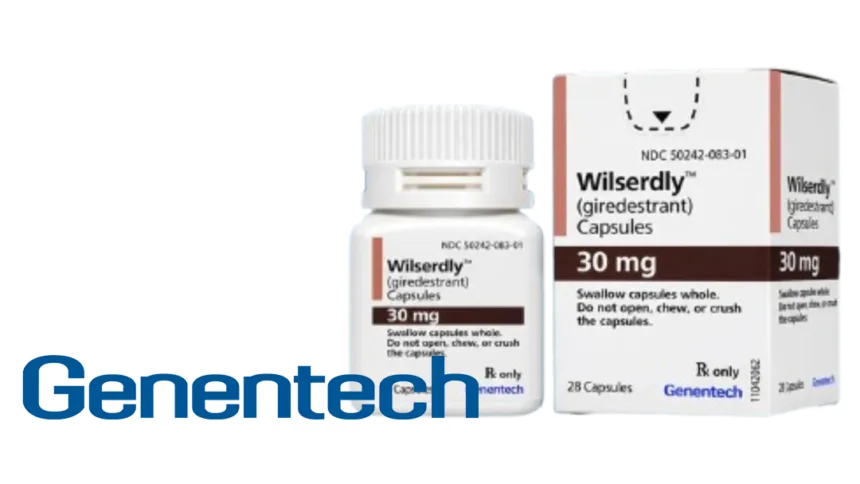
Genentech, a member of the Roche Group (SWX: ROP; OTCMKTS: RHHBY), announced that the U.S. Food and Drug Administration (FDA) has approved WILSERDLY (giredestrant) as a single agent for the adjuvant treatment of adults with estrogen receptor (ER)‑positive, HER2‑negative, stage I–III breast cancer at intermediate to high risk of recurrence.
Regulatory Milestone
| Item | Detail |
|---|---|
| Agency | FDA (United States) |
| Approval Type | Standard approval, adjuvant monotherapy |
| Product | WILSERDLY (giredestrant), oral |
| Indication | Adjuvant treatment of adults with ER‑positive, HER2‑negative, stage I, II, and III breast cancer at intermediate to high risk of recurrence |
| Approval Date | 23 Nov 2026 |
| Prior Approval | WILSERDLY + everolimus in ER‑positive, HER2‑negative, ESR1‑mutated locally advanced or metastatic breast cancer (FDA‑authorized test; post–endocrine therapy recurrence or progression) |
| Label Distinction | First and only SERD approved in both early‑stage and advanced breast cancer |
Drug Profile & Mechanism of Action
- Molecule: Giredestrant, branded WILSERDLY – a next‑generation, potent, oral selective estrogen receptor degrader (SERD) and full antagonist.
- Mechanism: Designed to achieve deep and sustained inhibition of ER signaling, addressing a principal driver of recurrence and resistance in ER‑positive breast cancer.
- Route & Convenience: Oral dosing, an adherence‑friendly alternative to injectable SERDs and a potential replacement for tamoxifen and aromatase inhibitors in the adjuvant setting.
- Platform Significance: The dual early‑stage and advanced approvals establish giredestrant as the benchmark oral SERD across the breast cancer continuum.
Clinical Evidence – Phase III lidERA Study
| Endpoint | Result (WILSERDLY) | Comparator (Standard Endocrine Therapy) | Relative Benefit |
|---|---|---|---|
| Invasive Disease Recurrence or Death | Reduced | Tamoxifen and aromatase inhibitors | 30 % lower risk |
| Overall Survival | Immature at analysis; clear positive trend | – | Trending favorably |
| Treatment Discontinuation Due to Adverse Events | 5.3 % | 8.2 % | Better tolerability |
The landmark Phase III lidERA study demonstrated that adjuvant WILSERDLY reduced the risk of invasive disease recurrence or death by 30 % versus standard endocrine therapy, including tamoxifen and aromatase inhibitors – the evidence base underpinning the FDA approval. Overall survival data were immature at the time of analysis, with a clear positive trend observed.
Market Impact & Outlook
- Adjuvant Standard of Care: A 30 % reduction in recurrence or death risk positions WILSERDLY to challenge two decades‑old pillars – tamoxifen and aromatase inhibitors – in the large early‑stage ER‑positive population.
- Dual‑Setting Monopoly: As the first and only SERD approved in both early‑stage and advanced breast cancer, WILSERDLY gains unique label breadth versus competing oral SERDs in development.
- Commercial Synergy: The recent metastatic‑setting approval in combination with everolimus for ESR1‑mutated disease, now paired with the adjuvant indication, enables patient capture across the disease trajectory.
- Tolerability Edge: Lower discontinuation rates versus standard endocrine therapy (5.3 % vs. 8.2 %) support long‑term adherence – a decisive factor in multi‑year adjuvant treatment.
Forward‑Looking Statements
This brief contains forward‑looking statements regarding clinical outcomes, overall survival maturation, regulatory timelines, and commercial expectations for WILSERDLY. Actual results may differ materially due to risks including final survival data interpretation, payer coverage, market adoption, and competitive dynamics in the oral SERD class.-Fineline Info & Tech