


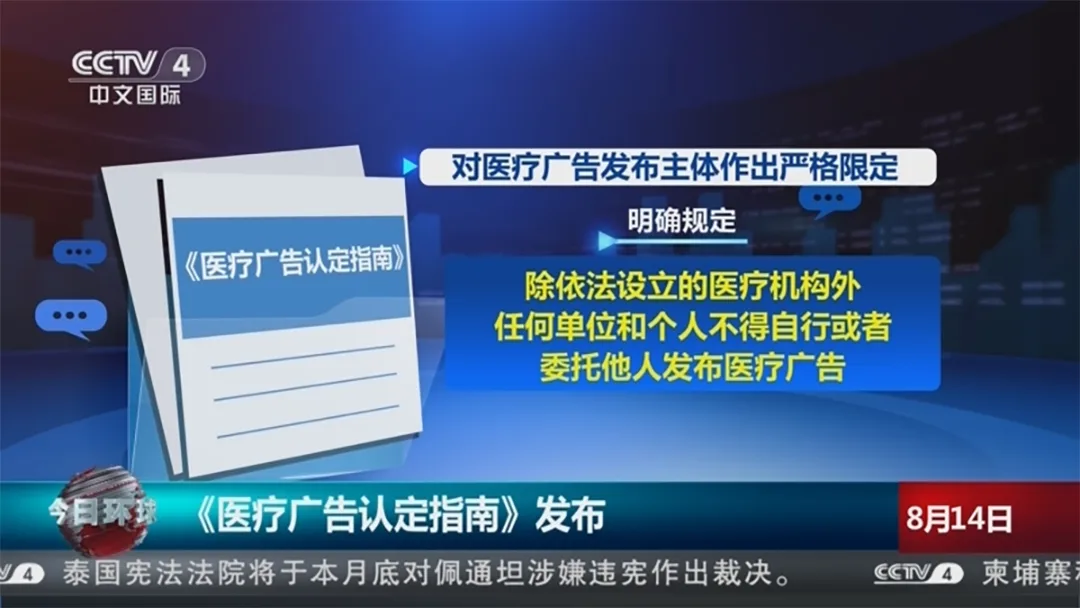
The State Administration for Market Regulation (SAMR), in collaboration with the National Health Commission (NHC) and the National Administration of Traditional Chinese Medicine, has formulated and issued the “Guidelines for the Identification of Medical Advertisements.” These guidelines define medical advertisements as those that directly or indirectly introduce medical institutions or services through various media and formats. Except for legally established medical institutions, no entity or individual may independently or through third parties publish medical advertisements. Market regulatory authorities are required to consider a combination of factors, including content, channels, and dissemination methods, when identifying medical advertisements.
Non-Advertising Scenarios
- Medical Research Purposes: Information published by medical institutions for research purposes, such as recruiting participants for studies and clinical trials.
- Patient Guidance: Actions taken by medical institutions to triage patients or guide them on seeking medical care, including online consultations and guidance during internet-based medical consultations.
- Institutional Information Disclosure: Information published by medical institutions on their premises, official websites, mobile apps, or certified “self-media” accounts, including institutional overviews, public service functions, key disciplines, medical staff information, medical service items, diagnostic and treatment procedures, and medical insurance, pricing, billing, and complaint methods, provided there is no intent to promote or compare with other institutions.
- Third-Party Platforms: Information provided by medical institutions through third-party e-commerce platforms in tabular form, introducing details such as the institution’s name, address, consultation hours, medical staff profiles, medical service items, diagnostic and treatment procedures, medical insurance policies, and pricing, provided there is no intent to promote or compare with other institutions.
Advertising Scenarios
- Promotion of Medical Environment and Equipment: Subjective promotion of the institution’s medical environment, equipment, and other facilities.
- Technical and Outcome Promotion: Promotion of the institution’s diagnostic and treatment techniques, procedures, or outcomes, or those of its medical staff, through subjective evaluations or guarantees.
- Comparisons with Other Institutions: Direct or indirect comparisons with other medical institutions.
- Other Promotional Content: Any information published with the intent to promote the institution.
Disguised Advertising in Health Science Communication
- Promotion of Specific Institutions: Highlighting diagnostic and treatment technical advantages, equipment advantages, and treatment outcomes to promote specific medical institutions and their services.
- Implied Benefits: Explicitly or implicitly suggesting that seeking medical care at specific institutions offers better safety guarantees, treatment outcomes, or price discounts.
- Service Promotion: Directly or indirectly promoting specific medical services provided by the institution or other medical institutions.
- Case Studies: Promoting specific medical institutions or their services through case studies or examples.
- Jump Links: Adding jump links to medical institutions or medical service items related to the science publicity content, or adding purchase links for drugs or medical devices necessary for the corresponding medical services promoted in the science publicity, on internet pages containing science publicity.
- Other Promotional Scenarios: Other scenarios involving the promotion of specific medical institutions or their services.
Regulatory Measures
For scenarios identified as medical advertisements, market regulatory authorities will enforce regulations in accordance with advertising laws. Advertisements will be deemed as having “serious circumstances” if they involve any of the following:
- Causing death, serious injury, disfigurement, or other severe threats to life and health.
- Suspected of constituting the crime of false advertising and thus requiring referral to public security organs.
- Promoting or directing traffic to non-medical institutions lacking legal credentials or to unregistered diagnostic and treatment items.
- Publishing illegal medical advertisements more than twice within a year, causing severe adverse social impacts.
- Other circumstances deemed as serious.-Fineline Info & Tech