


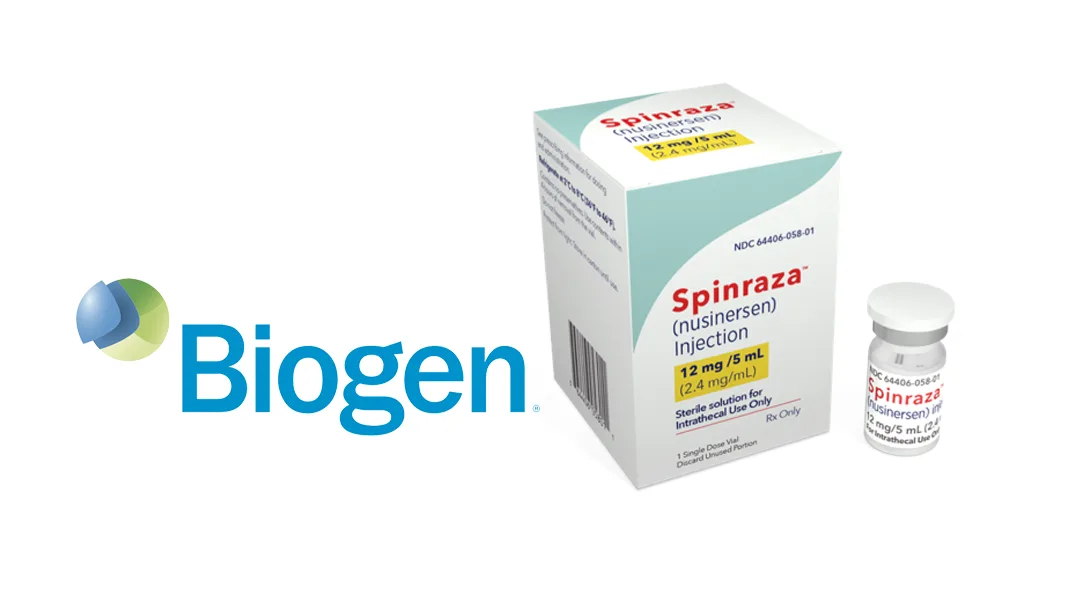
Biogen Inc. (NASDAQ: BIIB) announced that the European Commission (EC) has granted marketing authorization for a high‑dose regimen of SPINRAZA (nusinersen) for the treatment of 5q spinal muscular atrophy (SMA), representing approximately 95% of all SMA cases. The approval follows a Complete Response Letter (CRL) from the U.S. FDA in September 2025, with a final U.S. decision expected by April 3 2026.
Contents
Regulatory Milestone
| Item | Detail |
|---|---|
| Regulatory Authority | European Commission (EU) |
| Product | SPINRAZA (nusinersen) High‑Dose Regimen |
| Dosage Forms | 50 mg/5 mL and 28 mg/5 mL |
| Indication | 5q spinal muscular atrophy (SMA) |
| Approval Date | 12 Jan 2026 |
| U.S. Status | CRL received Sep 2025; FDA decision due Apr 3 2026 |
| Japan Status | High‑dose regimen already approved |
Drug Profile & Dosing Regimen
- Mechanism: Antisense oligonucleotide that increases SMN protein production by modifying SMN2 pre‑mRNA splicing
- High‑Dose Regimen:
- Loading Phase: Two 50 mg doses administered 14 days apart (vs. five 12 mg doses over 14+64 days)
- Maintenance: 28 mg injections every 4 months (vs. 12 mg every 4 months)
- Transition: Patients on 12 mg regimen receive one 50 mg dose in place of next 12 mg dose, then switch to 28 mg maintenance
- Rationale: Higher loading dose aims for faster motor function improvements and more durable SMN protein elevation
Clinical Evidence – DEVOTE Study
| Cohort | Population | Primary Endpoint | Result | Comparator |
|---|---|---|---|---|
| Pivotal Cohort | Treatment‑naïve symptomatic infants (n = 59) | CHOP‑INTEND motor function at 6 months | Statistically significant improvement (p < 0.001) vs. sham | Matched sham group from ENDEAR study |
| Open‑Label Cohort | Broad age/SMA types transitioning from 12 mg (n = 48) | CHOP‑INTEND change from baseline | Mean +8.5 points at 6 months | Historical low‑dose controls |
| Long‑Term Extension | All DEVOTE participants | Safety & durability | Sustained improvements through 12 months | Ongoing |
| Safety | All treated patients (N = 107) | Grade ≥ 3 TEAEs | 18 % (consistent with SMA disease/nusinersen profile) | No new safety signals |
- Study Design: Three‑part Phase 2/3 DEVOTE study with ongoing long‑term extension
- Key Finding: High‑dose regimen achieved faster onset of action and greater magnitude of motor improvement vs. historical low‑dose data
Market Opportunity & Strategic Outlook
| Parameter | 2026E | 2027E | 2028E |
|---|---|---|---|
| Global SMA Market | $1.85 billion | $2.1 billion | $2.35 billion |
| 5q SMA Share | 95 % | 95 % | 95 % |
| EU Market Size | $420 million | $460 million | $490 million |
| High‑Dose SPINRAZA EU Launch | Q2 2026 | Full rollout | Market penetration |
| Peak EU Market Share | – | 35 % | 42 % |
| Peak EU Revenue | – | $161 million | $206 million |
- Unmet Need: 15‑20 % of patients on low‑dose SPINRAZA plateau in motor function; high‑dose offers rescue option
- Pricing: EU high‑dose price estimated at +30 % premium over 12 mg (€125,000 vs. €96,000 per loading phase)
- Japan Approval: High‑dose approved in 2025; reimbursement secured at comparable premium
- U.S. Outlook: CRL requested additional CMC details and IV administration feasibility data; Biogen resubmission expected Q1 2026
- Competitive Landscape:
- Gene therapies (Zolgensma, Evrysdi) dominate new‑patient market
- High‑dose SPINRAZA targets maintenance population and non‑responders – complementary positioning
Strategic Positioning
- Manufacturing: High‑dose formulation produced at Biogen’s Solothurn, Switzerland facility; no new capacity required
- Patent Extension: High‑dose regimen extends EU patent protection to 2039 (vs. 2034 for 12 mg) via new dosing regimen patent
- Patient Conversion: Biogen launching switch program for existing patients; estimated 25 % conversion by 2027 , generating €80 million incremental revenue without new patient acquisition
- Pipeline Synergy: High‑dose data may support similar regimen for BIIB115 (next‑generation antisense) in development
Forward‑Looking Statements
This brief contains forward‑looking statements regarding SPINRAZA high‑dose commercial performance, FDA approval timeline, and competitive positioning. Actual results may differ due to regulatory decisions, pricing negotiations, and gene therapy adoption rates.-Fineline Info & Tech