


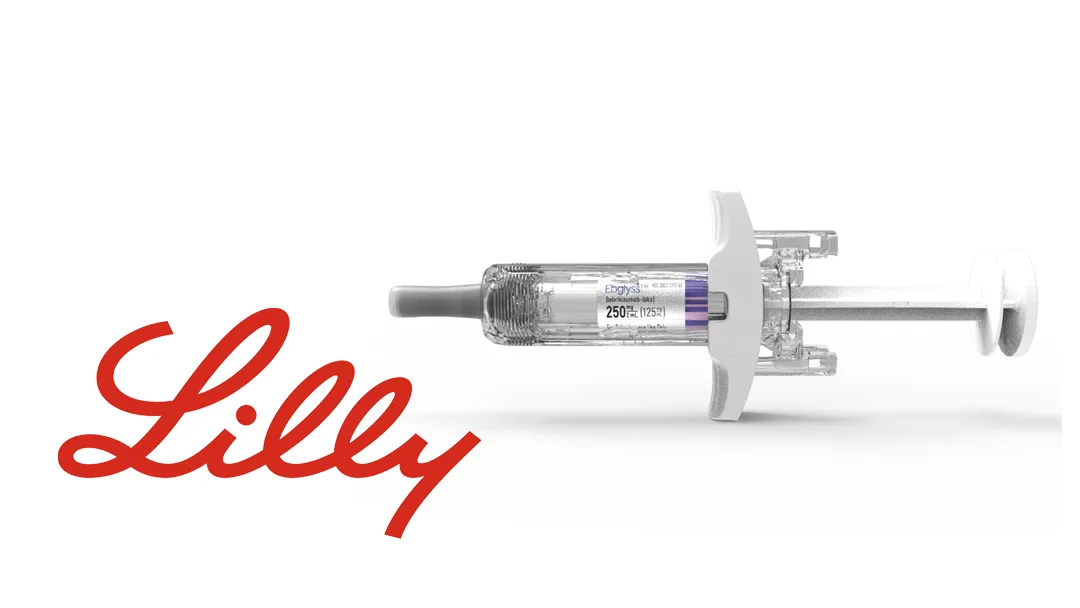
Eli Lilly and Company (NYSE: LLY) reported new long-term data from an open-label extension study showing that Ebgkyss™ (lebrikizumab), a high-affinity interleukin-13 (IL-13) inhibitor, delivered sustained skin clearance and itch relief for up to four years in patients with moderate-to-severe atopic dermatitis (AD). The results support the durability of once-monthly maintenance dosing and underscore IL-13’s pivotal role in driving type 2 skin inflammation.
Clinical Data Snapshot
| Endpoint | Result (Lebrikizumab) | Significance |
|---|---|---|
| Duration of Efficacy | Up to 48 months | Longest sustained AD control reported for an IL-13–targeted biologic |
| Dosing Regimen | Once-monthly subcutaneous maintenance | Improved adherence vs. weekly alternatives |
| Primary Mechanism | Selective blockade of IL-13 signaling via IL-13Rα1/IL-4Rα heterodimer disruption | Prevents receptor complex formation with slow dissociation kinetics |
| Target Specificity | Binds IL-13 at site overlapping IL-4Rα interface | Minimizes off-target effects; preserves IL-4 pathway integrity |
The data build on Phase III trials that led to regulatory approvals across major markets between 2023 and 2024.
Regulatory & Commercial Status
- Approved in:
- European Union (2023)
- United States, Japan, Canada (2024)
- Indication: Moderate-to-severe atopic dermatitis in adults and adolescents
- Differentiation: Among the most selective IL-13 inhibitors approved, with no cross-inhibition of IL-4—a design choice aimed at preserving immune homeostasis while suppressing eczema pathology.
Scientific Rationale
Atopic dermatitis is driven by a self-amplifying type 2 inflammatory loop in the skin, where IL-13 acts as a central cytokine promoting:
- Epidermal barrier dysfunction
- Pruritus (itch) via sensory neuron sensitization
- Fibrosis and chronic skin remodeling
By precisely neutralizing IL-13 without disrupting IL-4–mediated host defense, lebrikizumab offers a mechanistically refined approach compared to broader JAK inhibitors or dual IL-4/IL-13 blockers.
Market Implications
- Competitive Landscape: Positions lebrikizumab as a durable, targeted alternative to dupilumab (Sanofi/Regeneron), which inhibits both IL-4 and IL-13.
- Patient Retention: Four-year efficacy supports long-term treatment continuity—critical in chronic AD management.
- Pricing & Access: Lilly has secured reimbursement in EU and U.S. Medicare Part D; Japan inclusion in NHI price list expected Q2 2026.
- Pipeline Synergy: Data may inform use in other IL-13–driven conditions (e.g., eosinophilic esophagitis, prurigo nodularis).
Forward‑Looking Statements
This brief includes forward-looking statements regarding clinical durability, market access, and therapeutic positioning. Actual outcomes may differ due to post-marketing surveillance findings, payer negotiations, and competitive dynamics.-Fineline Info & Tech