



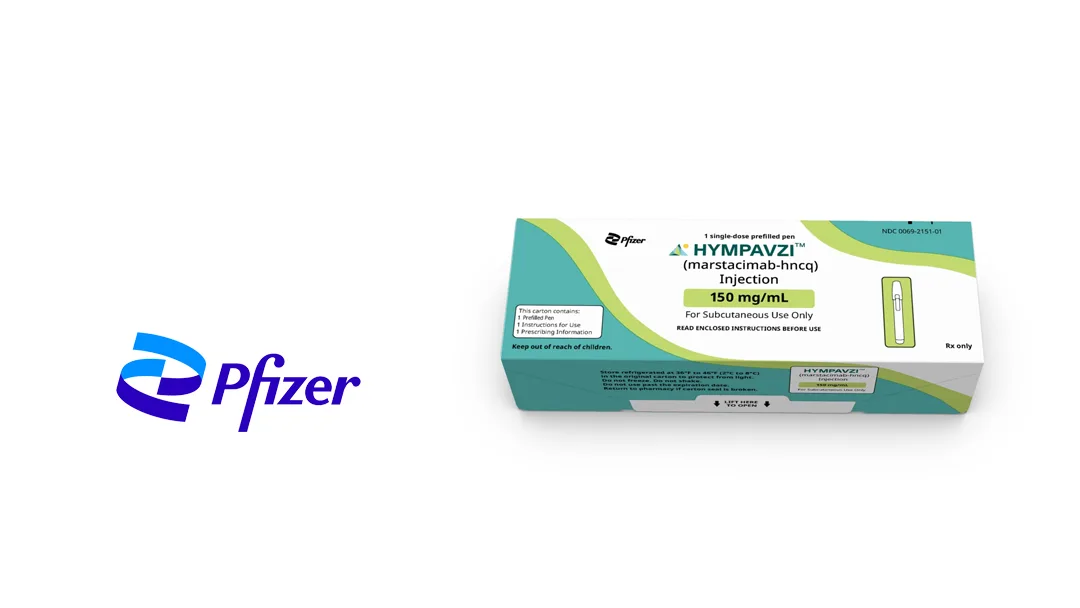
Pfizer Inc. (NYSE: PFE) announced it has received European Commission (EC) approval for an indication extension of its Hympavzi (marstacimab) as a treatment for patients aged 12 years and older weighing at least 35 kg with hemophilia A (congenital factor VIII deficiency) with factor VIII (FVIII) inhibitors, or hemophilia B (congenital factor IX deficiency) with factor IX (FIX) inhibitors.
Regulatory Milestone & Patient Population
| Component | Detail |
|---|---|
| Company | Pfizer Inc. (NYSE: PFE) |
| Regulatory Authority | European Commission (EC) |
| Approval Type | Indication extension |
| Patient Population | Ages ≥12 years, weight ≥35 kg |
| Indications | Hemophilia A with FVIII inhibitors; Hemophilia B with FIX inhibitors |
| Therapeutic Class | Non-factor therapy |
Drug Profile & Innovative Mechanism of Action
- Molecule: Marstacimab – novel non-factor therapy for hemophilia
- Mechanism: “Coagulation rebalancing via targeting TFPI”
- Target: Tissue Factor Pathway Inhibitor (TFPI) – natural coagulation inhibitor
- Specific Binding: Targets Kunitz 2 domain of TFPI
- Therapeutic Goal: Re-establish balance between bleeding and hemostasis
- Administration: Fixed-dose, once-weekly subcutaneous injection
- Differentiation: Does not replace missing clotting factors; instead modulates natural coagulation regulation
Strategic Significance & Market Context
Addressing High-Unmet Need Population
Inhibitor-Positive Hemophilia Challenge:
- Prevalence: ~30% of severe hemophilia A patients develop inhibitors; ~1-3% of hemophilia B patients
- Treatment Complexity: Inhibitor-positive patients have limited effective treatment options
- Current Standard: Bypassing agents (rFVIIa, aPCC) requiring frequent intravenous administration
- Clinical Burden: Higher bleeding rates, increased morbidity, and reduced quality of life
Competitive Differentiation Advantages
- Non-Factor Approach: Eliminates risk of additional inhibitor development against replacement factors
- Subcutaneous Administration: Weekly dosing offers significant convenience over daily IV therapies
- Fixed Dosing: Simplified regimen without need for pharmacokinetic monitoring
- Novel Target: TFPI inhibition represents innovative mechanism distinct from existing therapies
Commercial Implications & Market Opportunity
European Hemophilia Market Dynamics:
- Premium Pricing Potential: Novel mechanisms in orphan indications typically command high value
- Reimbursement Advantage: Addresses critical unmet need in inhibitor-positive population
- Market Expansion: Builds on existing Hympavzi franchise in broader hemophilia population
- Global Strategy: European approval supports worldwide regulatory filings
Patient-Centric Benefits:
- Reduced Treatment Burden: Weekly subcutaneous vs. frequent intravenous administration
- Improved Adherence: Simplified fixed-dose regimen enhances compliance
- Quality of Life: Potential for better bleeding control and reduced hospital visits
- Home Administration: Subcutaneous format enables self-administration
Development Pipeline Context
This indication extension represents Pfizer’s continued investment in expanding Hympavzi’s therapeutic utility across the hemophilia spectrum. The approval validates the coagulation rebalancing approach as a viable alternative to traditional factor replacement, particularly in the challenging inhibitor-positive population.
The success of marstacimab could establish TFPI targeting as a new standard of care for inhibitor-positive hemophilia patients, potentially displacing current bypassing agents through superior convenience and efficacy profiles.
Forward‑Looking Statements
This brief contains forward-looking statements regarding regulatory approvals, market adoption, and therapeutic benefits of Hympavzi. Actual results may differ due to risks including competitive dynamics, reimbursement challenges, real-world effectiveness, and evolving treatment guidelines.-Fineline Info & Tech