


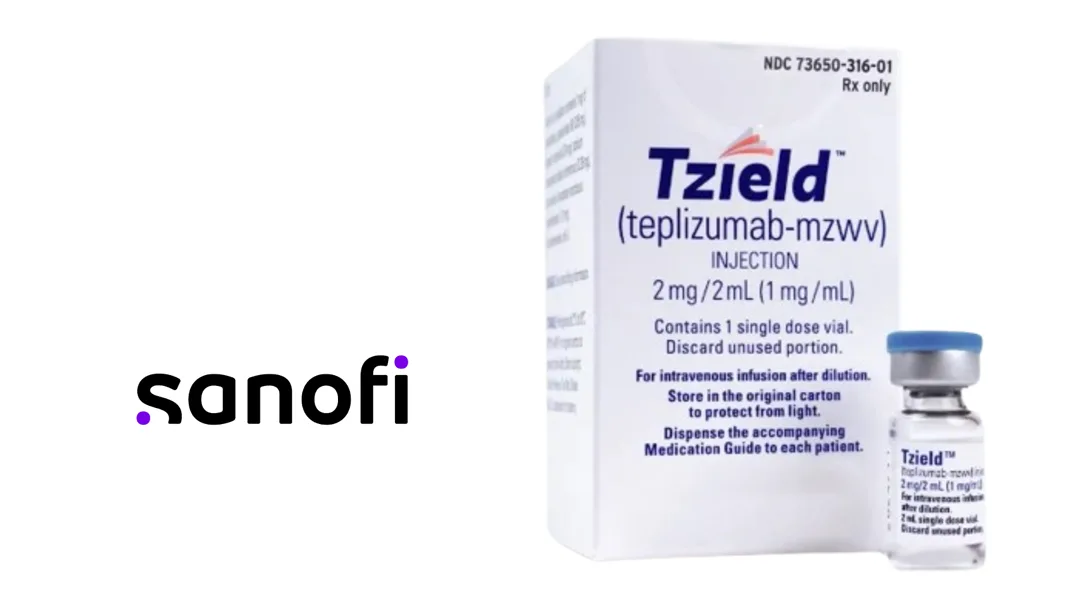
Sanofi (NASDAQ: SNY) announced that the U.S. Food and Drug Administration (FDA) has granted accelerated approval for Tzield (teplizumab) to delay the decline in endogenous (self) insulin production in children and adolescents aged 8 to 17 with recently diagnosed stage 3 type 1 diabetes (T1D). This marks the first disease-modifying therapy approved for autoimmune T1D in the post-diagnosis setting.
Regulatory Milestone
| Item | Detail |
|---|---|
| Agency | FDA (United States) |
| Approval Type | Accelerated approval |
| Product | Tzield (teplizumab) |
| Indication | Delay decline in endogenous insulin production in stage 3 T1D |
| Patient Population | Children and adolescents aged 8-17 with recently diagnosed T1D |
| Approval Basis | Phase 3 PROTECT study + broader clinical development program |
Clinical Trial Results – PROTECT Study
| Endpoint | Tzield | Placebo | Difference (95% CI) | p-value |
|---|---|---|---|---|
| C-peptide AUC (4-hour MMTT) | Preserved beta-cell function | Accelerated decline | LS mean difference: 0.13 pmol/mL [0.09–0.17] | <0.001 |
| Primary Outcome | Significantly slowed decline in mean C-peptide levels | — | — | Highly significant |
Trial Design Highlights
- ClinicalTrials.gov: NCT03875729
- Patient Population: Children and adolescents with recently diagnosed stage 3 T1D
- Primary Endpoint: Beta-cell function measured by C-peptide area under the curve
- Safety Profile: Adverse events consistent with previous studies
Product Profile & Mechanism of Action
- Molecule: CD3-targeting monoclonal antibody
- Mechanism: Modulates immune response to preserve pancreatic beta-cell function
- Therapeutic Innovation: First disease-modifying therapy for autoimmune T1D
- Administration: Intravenous infusion regimen
Regulatory History & Global Status
| Date | Milestone | Indication |
|---|---|---|
| November 2022 | Initial US approval | Delay progression from stage 2 to stage 3 T1D (≥8 years) |
| April 2026 | US indication expansion | Extended to children as young as 1 year old |
| June 2026 | New US approval | Preserve insulin production in stage 3 T1D (8-17 years) |
| Multiple Markets | International approvals | Stage 2 to stage 3 delay (≥8 years) in UK, EU, China, Australia, Canada, Israel, Saudi Arabia, UAE, Kuwait, Brazil, Switzerland |
Market Impact & Therapeutic Significance
- T1D Treatment Paradigm: Shifts from purely symptomatic management to disease modification
- Clinical Benefit: Preserved endogenous insulin production associated with better glycemic control and reduced complications
- Patient Population: Addresses critical unmet need in pediatric and adolescent T1D
- Commercial Opportunity: Expands Tzield’s addressable market beyond prevention to early treatment setting
Strategic Implications
This approval represents a major advancement in autoimmune diabetes therapeutics, demonstrating that immune modulation can preserve beta-cell function even after clinical diagnosis. The success builds on Sanofi’s established position in T1D with Tzield’s previous approvals for disease prevention.
Implementation Considerations
- Treatment Window: Early intervention critical for optimal beta-cell preservation
- Healthcare Integration: Requires coordination between endocrinology and infusion centers
- Monitoring Requirements: C-peptide testing and glycemic monitoring for treatment response assessment
- Reimbursement Strategy: High-value therapy requiring demonstration of long-term clinical and economic benefits
Future Development Outlook
- Additional Indications: Potential expansion to adult T1D population
- Combination Therapies: Exploration with other immunomodulatory agents
- Long-term Outcomes: Ongoing studies to assess impact on diabetes complications and quality of life
- Global Expansion: Continued regulatory submissions in additional markets
Forward‑Looking Statements
This brief contains forward-looking statements regarding regulatory approvals, clinical development, and commercial expectations. Actual results may differ due to risks including competitive dynamics, market adoption, and long-term clinical outcomes.-Fineline Info & Tech