


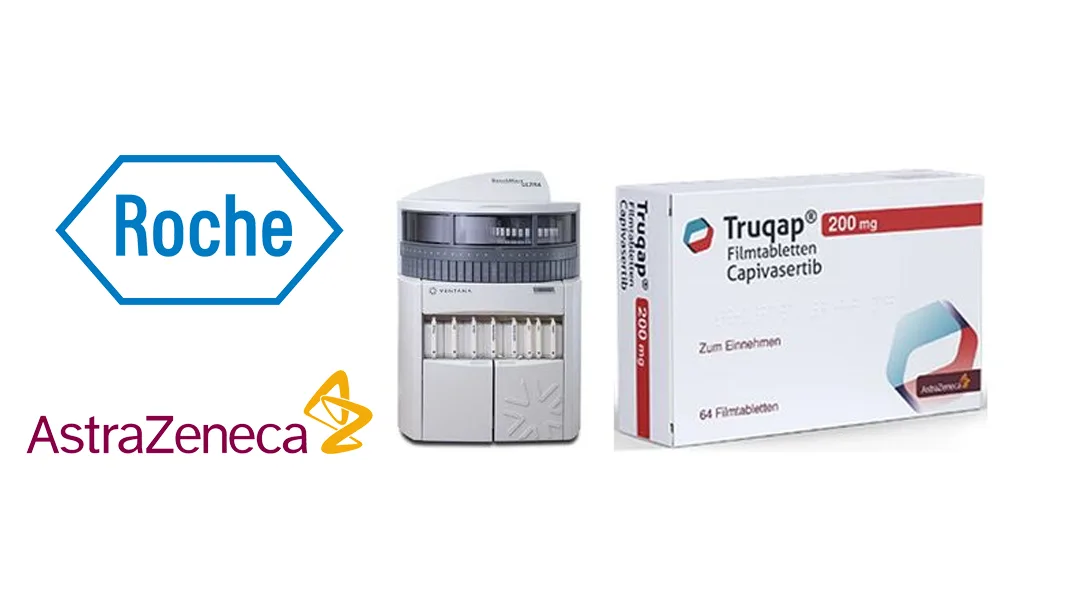
Roche Holding AG (SWX: ROP, OTCMKTS: RHHBY) announced that the VENTANA PTEN (SP218) RxDx Assay has received approval from the U.S. Food and Drug Administration (FDA) as the first immunohistochemistry (IHC) companion diagnostic test for detecting PTEN protein loss (PTEN deficiency) in tumor tissue from patients with prostatic adenocarcinoma. This approval enables identification of patients eligible for treatment with AstraZeneca’s targeted therapy Truqap (capivasertib) in combination with abiraterone acetate.
Regulatory Milestone
| Item | Detail |
|---|---|
| Agency | FDA (United States) |
| Approval Type | Companion diagnostic approval |
| Test Name | VENTANA PTEN (SP218) RxDx Assay |
| Indication | Detection of PTEN protein loss in prostatic adenocarcinoma |
| Therapeutic Link | Patient selection for AstraZeneca’s Truqap + abiraterone acetate |
| Significance | First IHC companion diagnostic for PTEN deficiency in prostate cancer |
Assay Technical Specifications
- Test Type: Qualitative immunohistochemistry (IHC) assay
- Target Analyte: PTEN protein expression in formalin-fixed paraffin-embedded (FFPE) tumor tissue
- Detection System: OptiView DAB IHC Detection Kit
- Instrument Platform: BenchMark ULTRA automated staining system
- Antibody Clone: SP218 monoclonal antibody
- Interpretation: Assessment of PTEN protein loss/deficiency status
Clinical Utility & Therapeutic Context
| Parameter | Detail |
|---|---|
| Patient Population | Prostatic adenocarcinoma with PTEN deficiency |
| Linked Therapy | Truqap (capivasertib) + abiraterone acetate |
| Treatment Setting | Metastatic androgen-naive or androgen-sensitive prostate cancer (mAPMN/S) |
| Biomarker Rationale | PTEN loss activates PI3K/AKT pathway, making tumors susceptible to AKT inhibition |
| Clinical Benefit | Enables precision medicine approach for biomarker-selected patients |
Strategic Partnership Implications
This approval represents a significant milestone in the precision oncology ecosystem, establishing a critical link between Roche’s diagnostic capabilities and AstraZeneca’s targeted therapy. The companion diagnostic ensures that only patients most likely to benefit from Truqap receive the treatment, optimizing clinical outcomes and healthcare resource utilization.
Market Impact Analysis
- Diagnostic Market: Creates new standard of care for PTEN testing in prostate cancer
- Therapeutic Adoption: Facilitates broader uptake of Truqap by providing validated patient selection tool
- Competitive Positioning: Roche strengthens its leadership in companion diagnostics for targeted cancer therapies
- Revenue Synergy: Drives both diagnostic test sales and therapeutic prescription volumes
Implementation & Accessibility
- Laboratory Integration: Available on widely deployed BenchMark ULTRA platform in pathology laboratories
- Workflow Compatibility: Seamless integration into existing IHC workflows for prostate cancer tissue analysis
- Training & Support: Roche Diagnostics provides comprehensive training and technical support for implementation
- Reimbursement Status: Expected favorable reimbursement given FDA approval and therapeutic linkage
Broader Precision Medicine Context
The VENTANA PTEN assay approval reflects the growing importance of biomarker-driven treatment selection in prostate cancer, following similar paradigms established in other solid tumors. PTEN deficiency occurs in approximately 40-50% of metastatic prostate cancers, representing a substantial patient population eligible for targeted AKT inhibition.
Future Development Opportunities
- Additional Indications: Potential expansion to other PTEN-deficient malignancies
- Global Approvals: Expected regulatory submissions in EU, Japan, and other major markets
- Combination Strategies: Support for future clinical trials combining AKT inhibitors with other targeted agents
- Digital Pathology Integration: Potential development of AI-assisted interpretation algorithms
Forward‑Looking Statements
This brief contains forward-looking statements regarding regulatory approvals, market adoption, and commercial expectations. Actual results may differ due to risks including competitive dynamics, reimbursement challenges, and market acceptance.-Fineline Info & Tech