


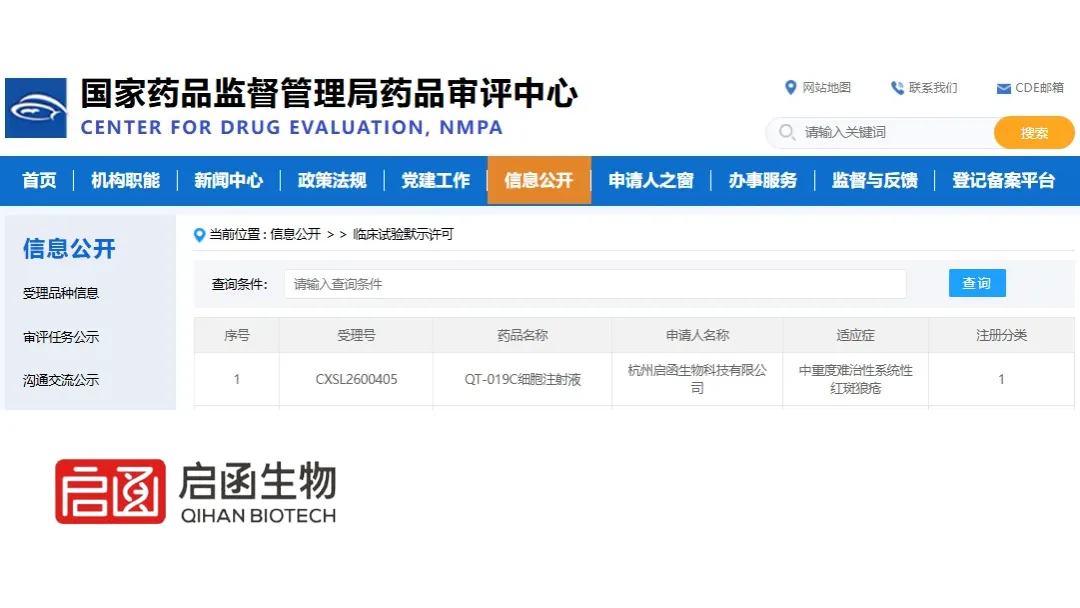
Hangzhou Qihan Biotech Engineering Life (“Qihan Biotech”) announced that its QT-019C cell injection has received clinical trial approval from China’s National Medical Products Administration (NMPA) for the treatment of moderate-to-severe refractory systemic lupus erythematosus (SLE). The therapy represents an “off-the-shelf” allogeneic CAR-T product engineered with dual-targeting capabilities against CD19 and BCMA.
Regulatory Milestone & Product Profile
| Item | Detail |
|---|---|
| Company | Hangzhou Qihan Biotech Engineering Life |
| Product | QT-019C cell injection |
| Classification | Allogeneic “off-the-shelf” CAR-T cell therapy |
| Indication | Moderate-to-severe refractory systemic lupus erythematosus (SLE) |
| Regulatory Body | NMPA (China) |
| Approval Type | Clinical trial approval |
| Announcement Date | 7 July 2026 |
Technology Platform & Molecular Design
- Dual CAR Architecture: QT-019C stably expresses two distinct chimeric antigen receptors (CARs) targeting CD19 and BCMA simultaneously, enabling comprehensive elimination of autoreactive B cells and plasma cells that drive SLE pathogenesis.
- Allogeneic Manufacturing: Produced from leukapheresis products of healthy donors, enabling scalable, standardized production compared to autologous approaches that require individual patient cell collection and processing.
- Safety Engineering: Multiple gene edits include TCR knockout to eliminate graft-versus-host disease (GvHD) risk and additional modifications to reduce immunogenicity, addressing key safety concerns associated with allogeneic cell therapies.
Systemic lupus erythematosus affects approximately 1 million patients in China, with 20-30% classified as refractory to conventional immunosuppressive therapies, representing a significant unmet medical need for novel therapeutic approaches.
Clinical Rationale & Therapeutic Innovation
B-Cell Targeting Strategy: By simultaneously targeting CD19 (expressed on B cells) and BCMA (expressed on plasma cells), QT-019C addresses both the cellular source of autoantibodies and the long-lived antibody-producing cells responsible for sustained disease activity.
Potential Curative Approach: Unlike chronic immunosuppressive therapies that require ongoing administration, CAR-T therapy offers the potential for durable remission or functional cure following a single treatment course, based on emerging data from other autoimmune indications.
Safety Profile Optimization: The extensive gene editing strategy aims to improve the risk-benefit profile compared to first-generation allogeneic CAR-T products, potentially enabling broader clinical application in non-oncological indications.
Market Implications & Competitive Positioning
- First-Mover Advantage: QT-019C appears to be among the first dual-target allogeneic CAR-T therapies to advance into clinical development for SLE in China, positioning Qihan Biotech at the forefront of autoimmune cell therapy innovation.
- Manufacturing Scalability: The “off-the-shelf” approach enables immediate treatment availability without the logistical complexities and delays associated with autologous manufacturing, potentially improving patient access and commercial viability.
- Platform Validation: Success in SLE could validate Qihan’s dual-CAR allogeneic platform for application across multiple autoimmune and inflammatory conditions, creating significant pipeline expansion opportunities.
Forward‑Looking Statements
This brief contains forward-looking information regarding clinical development, regulatory approvals, and therapeutic innovation. Actual results may differ due to clinical trial outcomes, safety findings, manufacturing challenges, and competitive developments.-Fineline Info & Tech