


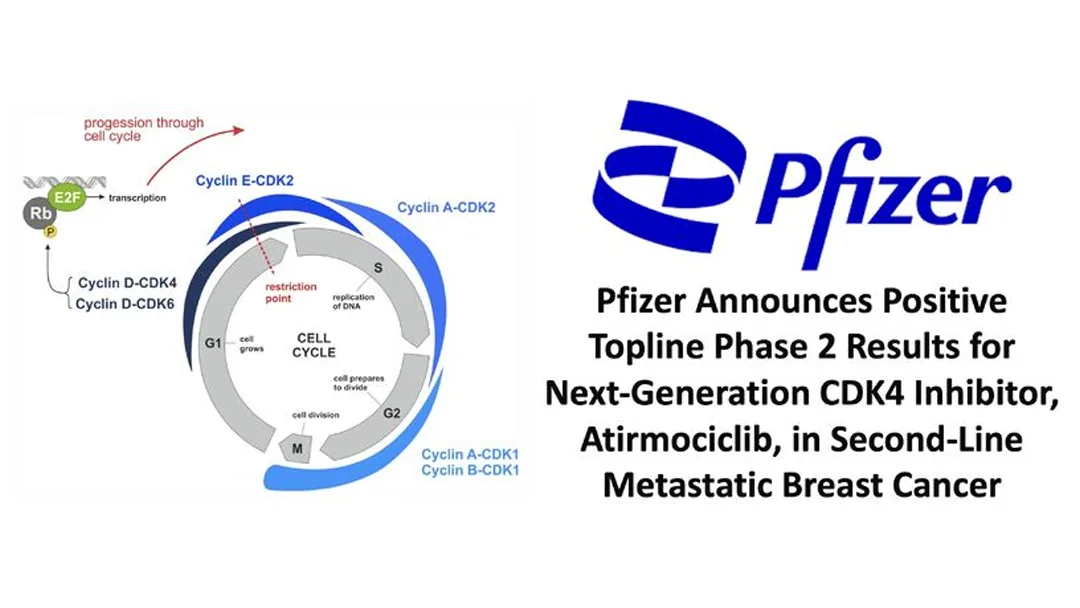
Pfizer Inc. (NYSE: PFE) announced positive topline results from the Phase II FOURLIGHT-1 study, demonstrating that atirmociclib in combination with fulvestrant achieved statistically significant and clinically meaningful improvement in progression-free survival (PFS) versus control regimens in patients with hormone receptor-positive (HR+), HER2-negative (HER2-) advanced or metastatic breast cancer (MBC) following prior CDK4/6 inhibitor therapy – a population with limited effective options after first-line targeted treatment failure.
Clinical Milestone – FOURLIGHT-1 Phase II
| Item | Detail |
|---|---|
| Study | FOURLIGHT-1 (Phase II) |
| Investigational Arm | Atirmociclib + fulvestrant |
| Control Arms | Fulvestrant alone; everolimus + exemestane |
| Patient Population | HR+/HER2- advanced/metastatic breast cancer |
| Prior Therapy Requirement | Previous CDK4/6 inhibitor treatment |
| Primary Endpoint | Progression-free survival (PFS) |
| Result | Statistically significant and clinically meaningful PFS improvement |
Drug Profile & Mechanism of Action
- Molecule: Atirmociclib – investigational CDK4 inhibitor
- Target: CDK4 (cyclin-dependent kinase 4) – key cell cycle regulator triggering cell division
- Development Status: Phase II (FOURLIGHT-1); Pfizer independently developed
- Therapeutic Hypothesis:
- CDK4-selective inhibition vs. pan-CDK4/6 inhibition (palbociclib, ribociclib, abemaciclib)
- Differentiated mechanism potentially addressing resistance or intolerance to prior CDK4/6 inhibitor therapy
- Combination with fulvestrant (ER degrader) for endocrine-resistant HR+ breast cancer
Clinical Context & Strategic Positioning
| Dimension | Current Standard | Atirmociclib Position |
|---|---|---|
| First-Line HR+/HER2- MBC | CDK4/6 inhibitor + aromatase inhibitor/fulvestrant | Post-CDK4/6 progression setting – high unmet need |
| Post-CDK4/6 Options | Limited: chemotherapy, everolimus-based regimens, single-agent endocrine therapy | Novel CDK4-selective approach with demonstrated PFS benefit |
| Resistance Mechanism | CDK4/6 inhibitor resistance often driven by CDK2 activation, Rb loss, or ESRI mutations | CDK4 selectivity may circumvent certain resistance pathways |
Market Impact & Outlook
- HR+/HER2- Breast Cancer Market: Global market exceeds US$20 billion annually; post-CDK4/6 progression population represents ~50% of advanced HR+ breast cancer patients with median 12-18 months survival after first-line failure – highest-unmet-need segment driving premium pricing.
- CDK4 Selectivity Differentiation: Atirmociclib’s CDK4-selective profile (vs. CDK4/6 dual inhibition) may offer improved tolerability (reduced neutropenia, diarrhea) and activity in CDK6-independent resistance mechanisms; FOURLIGHT-1 data supports Phase III trial design with potential for accelerated regulatory pathways.
- Pfizer Oncology Pipeline Validation: Atirmociclib represents lead asset in Pfizer’s targeted oncology portfolio following divestiture of legacy oncology products to Seagen; positive Phase II data supports internal pipeline prioritization and potential combination studies with other Pfizer assets (PD-1 inhibitors, antibody-drug conjugates).
- Competitive Landscape: Post-CDK4/6 space crowded with emerging therapies (AKT inhibitors, PI3K inhibitors, next-generation SERDs); atirmociclib’s PFS benefit and Pfizer’s commercial infrastructure in breast oncology create competitive positioning vs. smaller biotech rivals.
- Clinical Catalyst Timeline: Phase III initiation expected H2 2026; potential for Breakthrough Therapy Designation based on FOURLIGHT-1 magnitude of benefit in defined unmet need population; approval target 2029-2030 assuming positive Phase III.
Forward‑Looking Statements
This brief contains forward‑looking statements regarding clinical development timelines, regulatory pathways, and commercial expectations for atirmociclib. Actual results may differ due to risks including Phase III trial design challenges, competitive dynamics, and regulatory requirements.-Fineline Info & Tech