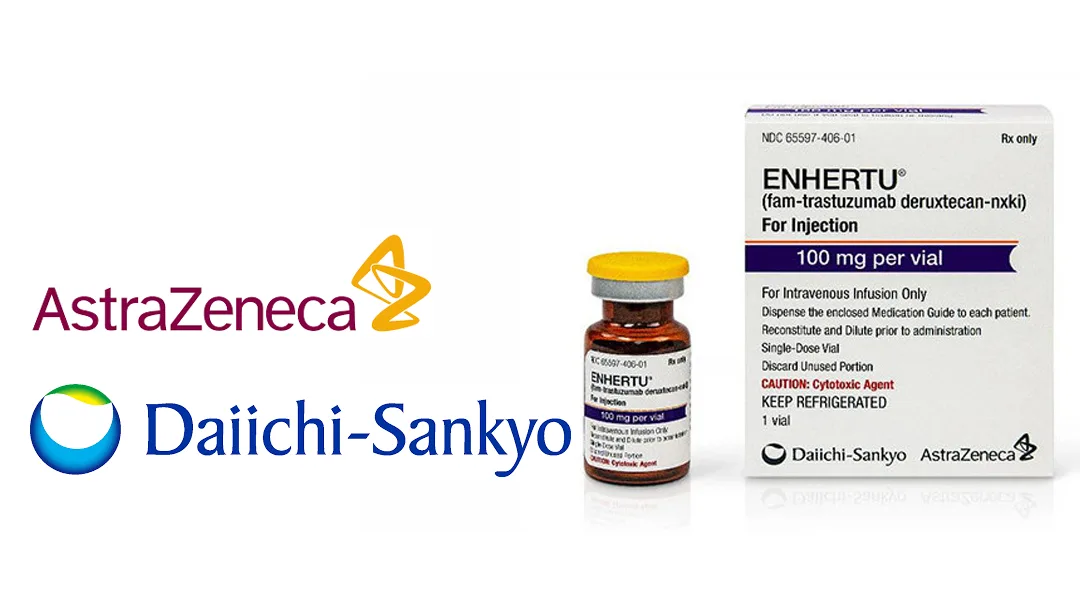
AstraZeneca (NYSE: AZN) and Daiichi Sankyo (TYO: 4568) announced that the U.S. Food and Drug Administration (FDA) has approved ENHERTU (fam-trastuzumab deruxtecan-nxki) for both neoadjuvant and adjuvant treatment of patients with HER2-positive early breast cancer, based on positive results from the DESTINY-Breast11 and DESTINY-Breast05 Phase 3 trials, respectively.
Regulatory Milestone
| Item | Detail |
|---|---|
| Agency | FDA (United States) |
| Approval Type | Dual indication approval (neoadjuvant + adjuvant) |
| Product | ENHERTU (fam-trastuzumab deruxtecan-nxki) – HER2-directed DXd ADC |
| Indications | HER2-positive early breast cancer (neoadjuvant and adjuvant settings) |
| Approval Date | 15 May 2026 |
| Global Status | Previously approved in 95+ countries for HER2-positive metastatic breast cancer |
Product Profile & Innovation
- Molecule: HER2-directed antibody drug conjugate (ADC) with DXd payload
- Technology: Specifically engineered with high drug-to-antibody ratio and membrane-permeable payload
- Development: Discovered by Daiichi Sankyo, jointly developed and commercialized globally by AstraZeneca and Daiichi Sankyo
- Therapeutic Expansion: First ADC to demonstrate efficacy in both neoadjuvant and adjuvant early breast cancer settings
Clinical Evidence – Dual Phase 3 Trial Success
DESTINY-Breast11 (Neoadjuvant Setting)
- Regimen: ENHERTU followed by THP (docetaxel, trastuzumab, pertuzumab)
- Primary Endpoint: Pathologic complete response (pCR) rate
- Results: 67.3% pCR with ENHERTU-based regimen vs. 56.3% with standard ddAC-THP
- Statistical Significance: Demonstrated superior pCR rates with clinically meaningful improvement
DESTINY-Breast05 (Adjuvant Setting)
- Population: Patients with residual invasive disease following neoadjuvant therapy
- Comparator: Trastuzumab emtansine (T-DM1)
- Primary Endpoint: Invasive disease-free survival (IDFS)
- Results: 53% reduction in risk of invasive disease recurrence or death (HR 0.47)
- Safety: No new safety concerns identified; consistent with established ENHERTU profile
Market Context & Competitive Landscape
HER2-positive breast cancer represents approximately 15-20% of all breast cancer cases, with early-stage disease affecting over 50,000 patients annually in the US. Current standard of care includes:
- Neoadjuvant: Anthracycline/taxane-based regimens with dual HER2 blockade
- Adjuvant: T-DM1 for patients with residual disease post-neoadjuvant therapy
ENHERTU’s competitive advantages:
- Dual setting approval provides comprehensive treatment continuum from neoadjuvant through adjuvant
- Superior pCR rates in neoadjuvant setting may translate to improved long-term outcomes
- Significant IDFS benefit in adjuvant setting establishes new standard of care for high-risk patients
- Established safety profile from extensive metastatic breast cancer experience
Commercial Implications
- Revenue Impact: Expected to significantly expand ENHERTU’s addressable market beyond metastatic setting
- Pricing Strategy: Premium pricing maintained across both new indications reflecting clinical superiority
- Market Penetration: Rapid adoption anticipated given strong clinical data and established physician familiarity
- Competitive Disruption: Likely to displace T-DM1 as adjuvant standard and challenge anthracycline-based neoadjuvant regimens
Strategic Significance
- ADC Leadership: Reinforces AstraZeneca and Daiichi Sankyo’s position as leaders in next-generation antibody drug conjugate development
- Treatment Paradigm Shift: Establishes ENHERTU as backbone therapy across the entire HER2-positive breast cancer continuum
- Global Harmonization: US approval supports ongoing regulatory submissions in other major markets
- Platform Validation: Success validates DXd ADC platform for early-stage disease applications beyond metastatic settings
Forward‑Looking Statements
This brief contains forward-looking statements regarding regulatory approvals, clinical outcomes, and commercial performance for ENHERTU. Actual results may differ due to risks including market adoption rates, competitive dynamics, and reimbursement decisions.-Fineline Info & Tech