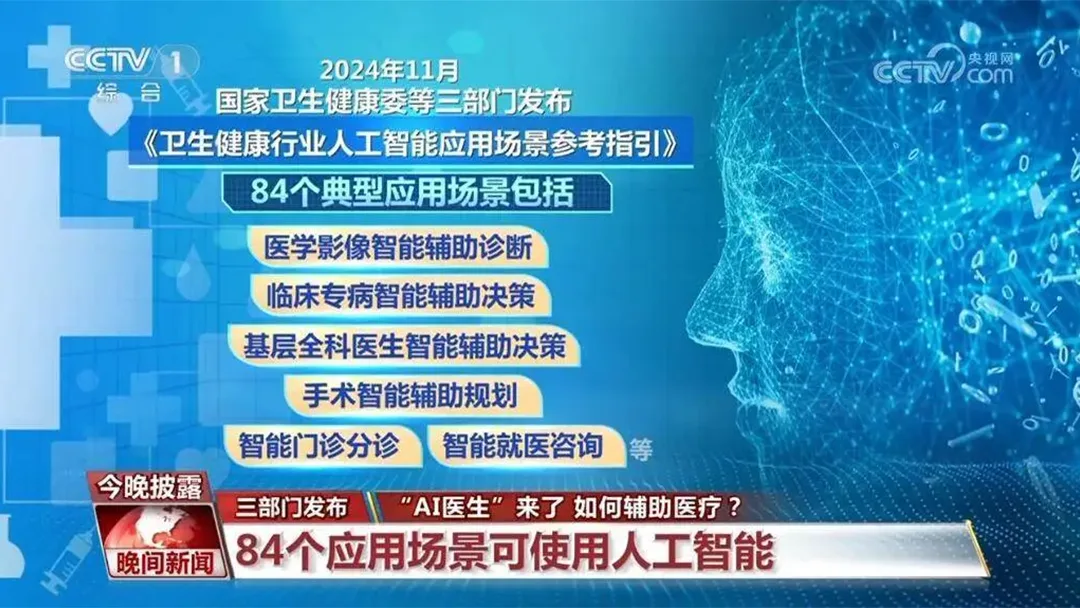
The National Health Commission (NHC) today released the Implementation Opinions on Promoting and Standardizing the Development of “Artificial Intelligence + Healthcare” (AI + Healthcare). The policy blueprint seeks to accelerate the standardized rollout of AI technologies across the Chinese health‑care system, expand use‑case coverage, and boost service capability for patients, clinicians, and industry players.
Contents
Core Scope – 24 Applications in 8 Strategic Directions
| Direction | Representative Applications (selected) |
|---|---|
| Grass‑roots AI | Remote triage bots, community‑clinic decision‑support tools |
| Clinical Diagnosis & Treatment | AI‑assisted imaging analysis, pathology‑recognition platforms |
| Patient Services | Intelligent appointment scheduling, medication‑adherence chatbots |
| Traditional Chinese Medicine (TCM) | AI‑driven syndrome differentiation, herbal‑formula recommendation |
| Public Health | Epidemic‑early‑warning AI, population‑risk modeling |
| Scientific Research & Education | AI‑powered drug‑target discovery, virtual simulation labs |
| Industry Governance | AI‑based compliance monitoring, supply‑chain risk analytics |
| Health‑Industry Development | Smart hospital management, AI‑enabled health‑insurance underwriting |
Five Pillars for Building a Robust AI + Healthcare Ecosystem
- Infrastructure Construction – Expand high‑speed health‑data networks and edge‑computing nodes in hospitals and community centers.
- Medical Data Enrichment – Create unified, interoperable datasets (EHR, imaging, genomics) with standardized labeling.
- AI Computing Power & Algorithms – Invest in next‑generation GPUs/TPUs and promote open‑source model libraries for diagnostic accuracy.
- Pilot‑Testing Bases – Designate 10 national demonstration zones (e.g., Beijing, Shanghai, Chengdu) for end‑to‑end AI workflow validation.
- Talent & Standards Support – Launch scholarships, joint‑industry‑academia labs, and fast‑track certification for AI‑health professionals.
Safety Supervision & Regulatory Innovation
| Focus | Action Items |
|---|---|
| Industry Management & Review | Refine product‑registration pathways; introduce AI‑risk‑classification tiers. |
| Regulatory & Early‑Warning Mechanisms | Deploy real‑time AI‑monitoring dashboards for adverse‑event detection; issue “AI safety alerts.” |
| Data Security & Privacy | Enforce strict de‑identification standards; require multi‑party consent frameworks for cross‑institutional data sharing. |
Policy‑Level Levers
- Institutional Development – Strengthen the NHC AI + Healthcare Coordination Office to oversee cross‑ministerial initiatives.
- Pilot Demonstrations – Accelerate “AI Hospital” projects with performance‑based funding.
- Publicity & Cooperation – Promote best‑practice case studies through national media and international forums.
- Technological Inclusivity – Ensure AI tools are accessible to under‑served rural regions via mobile‑edge solutions.
- Shared Outcomes – Align incentives for hospitals, insurers, and tech firms to jointly capture efficiency gains and health‑outcome improvements.
Forward‑Looking Statements
This brief contains forward‑looking statements regarding the implementation timeline, regulatory impact, and market effects of China’s AI + Healthcare policy. Actual outcomes may differ due to legislative revisions, technology adoption rates, and industry response.-Fineline Info & Tech